I have been using black, African, coloured, white, and Indian to describe people in South Africa. These are terms that are used here, but they understate the cultural diversity of South Africa.
There are eleven official languages in South Africa. Nine of the eleven are southern Bantu languages. Listed by percentage of the population that speaks them, they are Zulu, Xhosa, Northern Sotho, Tswana, Sotho, Tsonga, Swazi, Venda and Ndebele. The big ones are Zulu at 22% of the population and Xhosa at 16%. This is not merely linguistic diversity, but tribes with distinct cultures and histories.
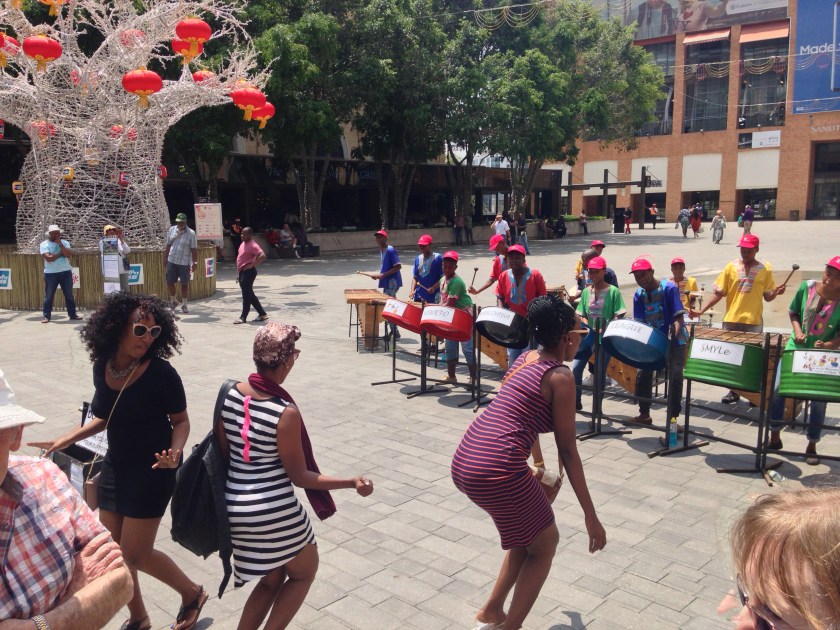
As the economic powerhouse of the region, South Africa has many immigrants from other nearby countries. There are many black Africans in South Africa from Zimbabwe, Mozambique and other neighboring countries–and bring their own heritage and language.
The two other official languages are European: English and Africaans. Africaans is short for African Dutch. There is a long history of antagonism between the English and the Dutch in South Africa. (Think voortrekkers and the Anglo-Boer war). My friend Claire described being called ‘English speaking’ as if that were a cultural label.
There is a large population of people of Indian heritage. The first Indians came to South Africa as slaves and in the early 1700s, 80% of the slaves in South Africa were Indian. Subsequent generations came largely as indentured servants, a practice which ended in 1911 in South Africa. Durban is the largest concentration of Indians in any city outside of India. India has amazing linguistic and cultural diversity of its own and there are still remnants of this in the Indians of South Africa.
This leaves us with the designation that is most confusing for me: coloured. Some of the people who identify or are identified as coloured are of mixed heritage or race, for example a black parent and a white parent (such as Trevor Noah). But it’s much more complicated than that. A genetic study identified coloured people of the Cape region as the most genetically diverse people in the world. Under the racial categorization of apartheid, the Coloured group was further sub-divided into Cape Malay, Khoisan, other Coloureds, Bastards, et al.
The original habititants of the Cape area were two tribes: the Khoi and the San. They had yellow brown skin. They also had no immunity to smallpox and other European diseases, so 90% of the members of these tribes died or were killed when the Europeans arrived in the mid-1600s. The Khoi San are trying to have their languages added to the list of official South African languages, to be officially identified as the original inhabitants of the area, and to not be called coloured. Jacob Zuma showed no sympathy for their case, but there might be progress under Cyril Ramaphosa.
The Dutch sent people who opposed their colonization of Indonesia and South East Asia to the Cape area of South Africa as slaves. Many of these people were Muslim. This included people from places like East Africa and Madagascar, but they all went under the label of Cape Malay.
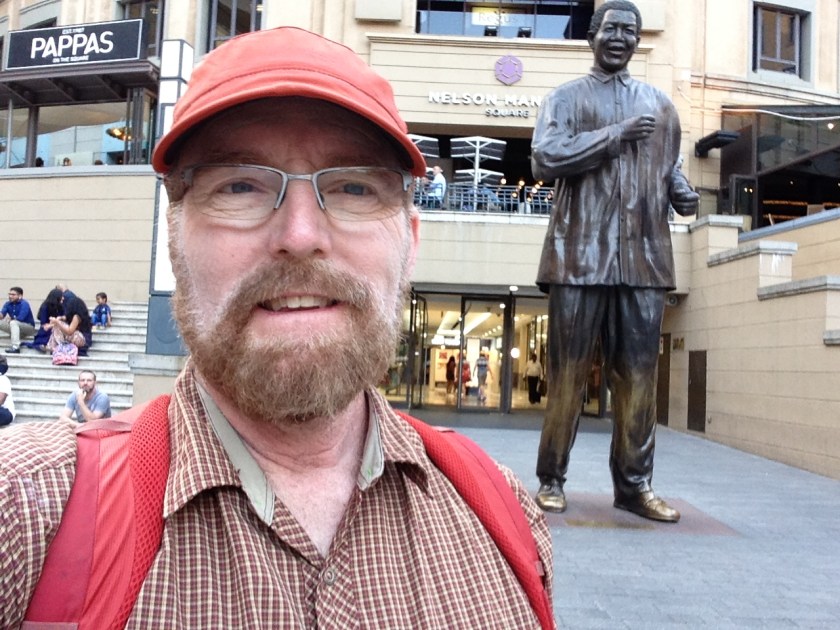 My last two days in South Africa before flying to Zambia, I spent at lot of time at Nelson Mandela Square in Sandton, a suburb of Johannesburg. Despite the lofty name, Nelson Mandela Square is a big shopping mall. Malls seem to be the centerpiece of social life in Joburg’s northern suburbs. Wandering the labyrinthine mall, seeing the variety of people walking them with me, I felt like I saw South Africa’s rainbow nation for the first time.
 No Foreign Lands