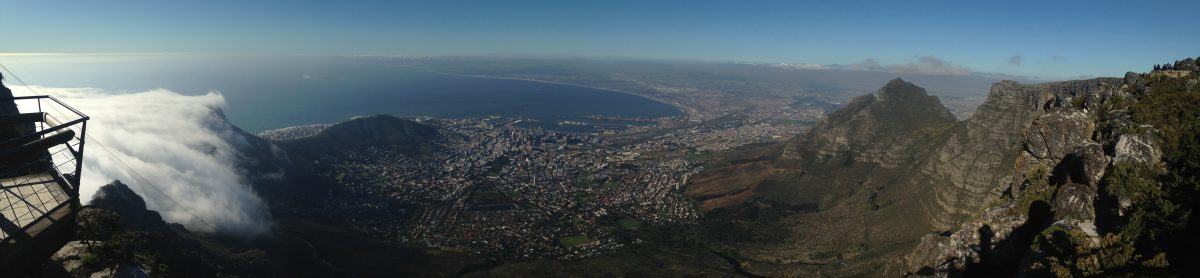
It’s Friday afternoon in Johannesburg on a gorgeous summer’s day. After a long swim, I sit poolside at my hotel. This is perhaps the most work-related week of my sabbatical. I’m staying at a nice but corporate hotel located immediately next to St. Stithians, a Round Square school. My days this week have been spent either visiting schools or visiting historical sites where I might bring Athenian students.
 Monday morning, I took Uber to central Johannesburg to tour Constitution Hill. I had a ticket for the 10:00 am full tour, but they asked if I would come back at 1:00. I went to explore central Jo’burg and, another Uber ride later, I was at Mary Fitzgerald Square (a labor leader). The area around the square looked sketchy and, given all the safety warnings I’ve been given, I headed in the other direction. I took a left at the first street. Suddenly the mood changed. There was an outdoor café across the street from a theatre–and there was a large mall just next to that. It turns out the South African International Film Festival is at that theatre this week and so I bought a ticket for the film at 8:00 that night.
 Constitution Hill is the site of an old jail, built before the city of Johannesburg was founded. A fort was added after the Jameson Raid in 1895, an attempt by the British to annex the area after gold was discovered. The jail was closed in the 1980s. After the end of apartheid in 1994, part of the prison was torn down and reconstructed to be the court buildings for the supreme court in South Africa—hence the name Constitution Hill.
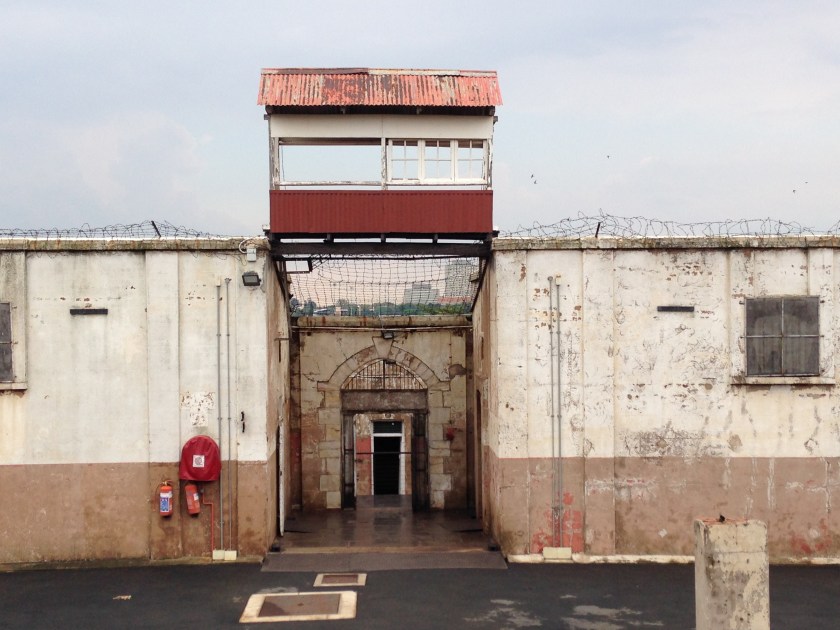
For six dollars, I ended up one-on-one with a great tour guide, Brenda, for over two hours. There were separate jails for men and women and then within that for white and non-white prisoners. As you might imagine, the conditions for the non-white prisoners were significantly worse—more crowded, less food, more humiliating. Brenda described how non-white prisoners were forced to take off all their clothes and do a ‘dance’ under the guise of the guards being able to make sure they weren’t hiding anything. I was reminded of the tactics at Neuengamme, a Nazi work camp outside Hamburg that I visited with students 18 months ago.
Some of the inmates at the Johannesburg jail were ordinary criminals. Some were political prisoners, the most famous being Mohandas Gandhi and Nelson Mandela. The political prisoners included whites who were opposed to apartheid and they were treated very harshly as well. Under apartheid, blacks had to carry a pass at all time or risk arrest. Some of the inmates were people who went out to do a chore, didn’t have their pass, and ended up in prison for months.
Brenda lives in Soweto. She talked about how transformative the World Cup was for South Africa and how it played a key role in launching her career as a guide. We explored the possibility of her organizing a tour of Soweto for Athenian students in the future.
Before the film, I hung out at the café across the plaza from the theatre and watched the directors and cast have their picture taken. There was not a large crowd for my film, with only 30-40 people in the audience. As it turns out, the film was based on a true story of a man who worked with prisoners in the 1980s to use drama to express truths about their lives. While the actual prison was in Durban, the movie was filmed at the prison on Constitution Hill. I couldn’t imagine a more fitting conclusion to my day.
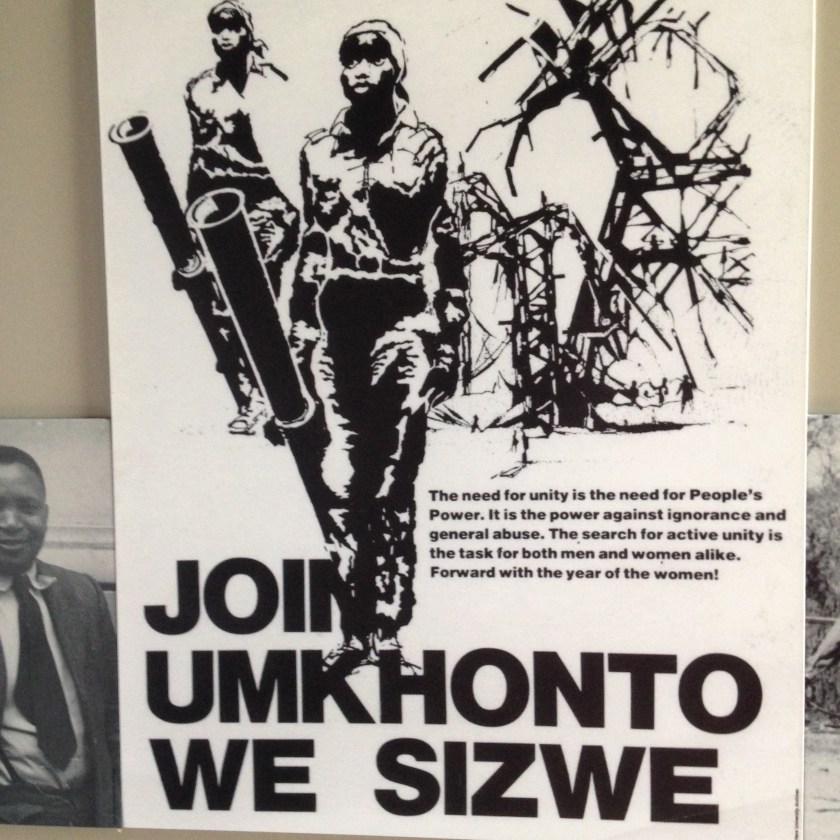
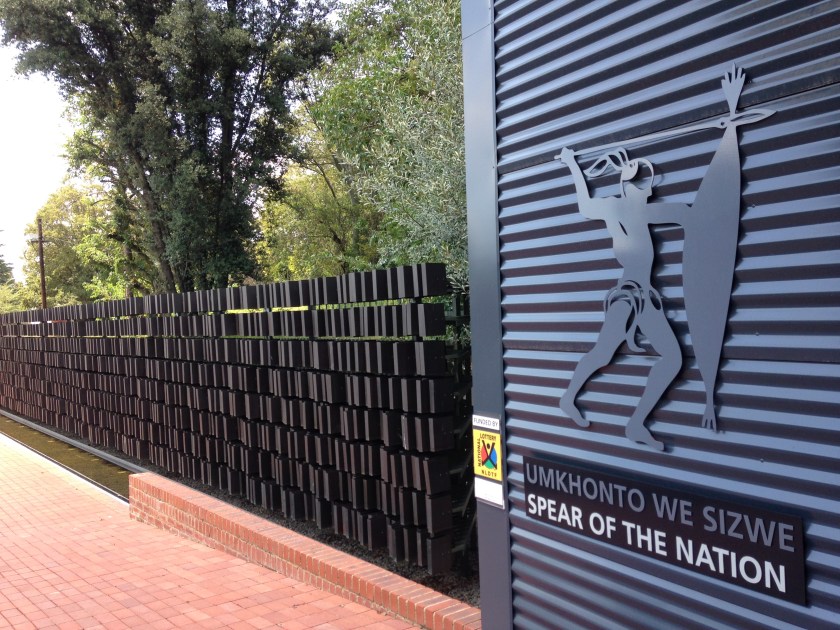 On Tuesday, I visited Liliesleaf Farm in the suburb of Rivonia. The farm was a secret meeting place for the African National Congress (ANC), which was a banned organization in South Africa for many decades. The ANC was worried that too many people knew about the farm’s existence and held one final meeting there. The police conducted a raid that very day and captured all the senior leadership of the ANC, which was a major setback for the liberation struggle. Nelson Mandela had been recently captured, the CIA providing all the information that led the South African Security Forces to him. The Rivonia Trial in 1963 included those arrested at the farm and Mandela. They were all convicted to life sentences—this is the sentence that sent Mandela to Robben Island for 30+ years—but the defendants were able to use the trial to publicize their cause to an international audience. It was interesting being at a museum site where the perspective provided was so opposed to that of the country’s government when the event occurred.
 On Wednesday, I was off to the African Leadership Academy. This is a unique school. It has 250 students from 40 African nations. Only 5% of the students are from South Africa, so it truly is a pan-African institution. They run a two-year program, which is the last two years of secondary school for some and comes after graduation from secondary school for others. In addition to traditional subjects, the school has three focus areas: entrepreneurial leadership, African history, and writing & rhetoric.
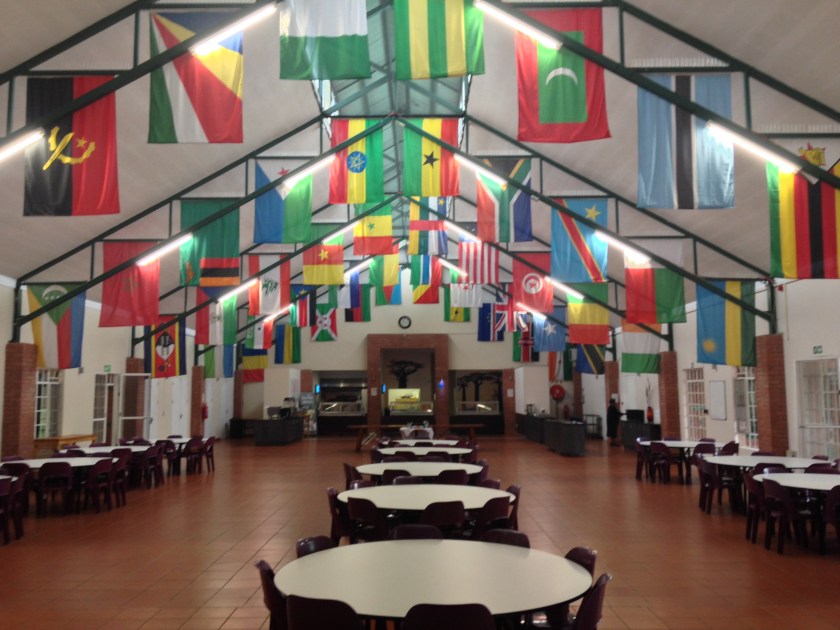
I had a fascinating day there: talking with a girl from Botswana about ethical leadership, hearing a girl from Zimbabwe say that she cringes every time she hears Robert Mugabe’s name, discussing with a boy from Morocco his plan to increase financial literacy among farmers in his country, listening to a history class debate whether Queen Amina of Nigeria should have statues honoring her. Just that morning I read about Sherman Alexie and the charges of sexual abuse against him. I mentioned him as another example of the challenges of deciding how to respond to people who do both good things and reprehensible things.
At the end of the day, I met with a group of teachers to discuss service learning and community service. While it is part of the school’s mission and goals, in practice they don’t do much of it. It’s interesting because there are 24 student-run enterprises as part of the entrepreneurial leadership program. It seems like this model would lead itself to having some enterprises that are focused on supporting groups or issues in the broader community, but this is not the case.
Thursday took me to Crawford College Lonehill. A girl from the school is coming to Athenian on exchange in March and we’re sending someone there in July & August. We’ve never worked with this school before, so it was good to establish a connection. I had dinner with the girl and her father. She’s confident, outgoing and hard-working. And she’s already into bubble tea, can’t wait to experience In ‘n’ Out Burger, and knows which chain stores aren’t in South Africa that she wants to visit. Her father lived in the United States for five years when he was a professional golfer. He said those were the best years of his life.
Today I was at St. Stithian’s Boys College. The school is 60 years old and there are now five schools on its huge campus. A hike around the perimeter of the property would cover six kilometers. This school is very different than Athenian. All boys. Lots of different ties and blazers and caps to designate students with different honors. Chapel three times a week, two of which are really school assemblies. The student leaders from the girls’ school came to the assembly I attended, which meant that the boys were much more agitated than usual. It was the end of a sports season and sports are big at Saints (as the school is known). Most of the assembly consisted of reading out the achievements of the athletes. Every sport was covered and, in many cases, there were medals and trophies distributed.
Their English classes include film studies. I sat in on a class that was analyzing the film The Secret Life of Walter Mitty. We got through ten minutes of the film as the teacher stopped the film every 45-60 seconds to discuss what was going on and to unpack the different cinematic effects being used (e.g. music, blocking).
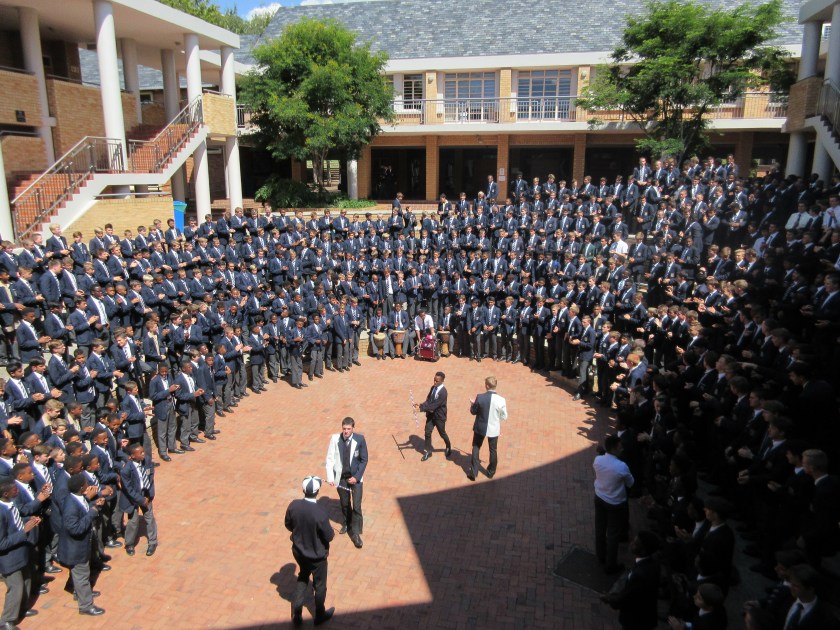 There were no classes during the last period of the day so that the boys, all 800+ of them, could practice the ‘war cries’ they chant at sporting events. This was quite a ritual to witness. One chant was a song that had revised lyrics to John Denver’s Take Me Home, Country Roads.
I spent a period chatting with Jonathan, who came on exchange to Athenian two years ago. He is now the Prefect for Round Square at the school. We talked about Saints and he was looking for ideas to improve Round Square at his school. I asked him how coming on exchange had effected him. He said it was one of the most profound experiences of his life. He said that not a day goes by when he doesn’t ask his parents about coming to visit Athenian again. He wanted to come for senior prom, but that didn’t happen. Now he’s shooting for coming back for graduation in June. He mentioned that homophobia was a problem at his school. Because he came on exchange to Athenian he has more ability to talk about homophobia than most of his peers and has taken some initiative on the issue at his school. Talking with him reminds me why I do this work.
 No Foreign Lands