 bakkie. Noun. 1. (South African) a small truck with an open body and low sides
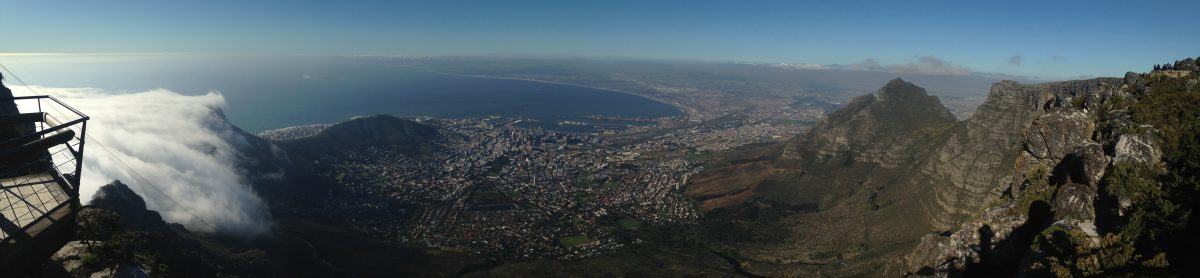
A warm autumn evening in Cape Town. Completely comfortable to sit outside, as I am now, without a jacket or sweatshirt. The two waitresses at the burger place I’m getting dinner are both white and have blonde hair.
Lisa, my wife, was here for the last two weeks. Now she is on a plane to London. It was fun to travel with her. To see her fall in love with the people and place—and to watch people fall in love with her. To see her reconnect her with her traveling self, a side that was prominent in her 20s. After ten weeks on my own, it was also different to travel with another person. And it didn’t leave any time for writing blog entries.
Lisa arrived in Johannesburg 14 days ago. We did Jo’ burg in a day: Apartheid Museum, walking tour of Soweto, Nelson Mandela Square. We passed Winnie Mandela’s house in Soweto. She died a couple of days ago and the flags in South Africa all fly at half-mast.
The bed-and-breakfast where we stayed is located in Johannesburg’s Jewish neighborhood. We were only there one day but saw many Jews walking around and shopping at the local Pick n Pay (which had not one but two sections of Kosher food). Our hosts were Jewish and the rabbi even came to visit them one day. It felt different—and nice–to be in South Africa amongst white people who were Jewish. Though like all of thethe northern suburbs of Jo’burg, the streets are kilometer after kilometer of walls with an occasional retail district mixed in.
We drove from Johannesburg to Cape Town over the course of ten days. Lisa’s first full day in South Africa we headed south on the N3 in our rental car for Drakensberg (mountains of dragons). For three hours we passed huge agricultural fields with barely a farm in sight. There were also beautiful red and white cosmos (not native to South Africa) in bloom alongside the road.
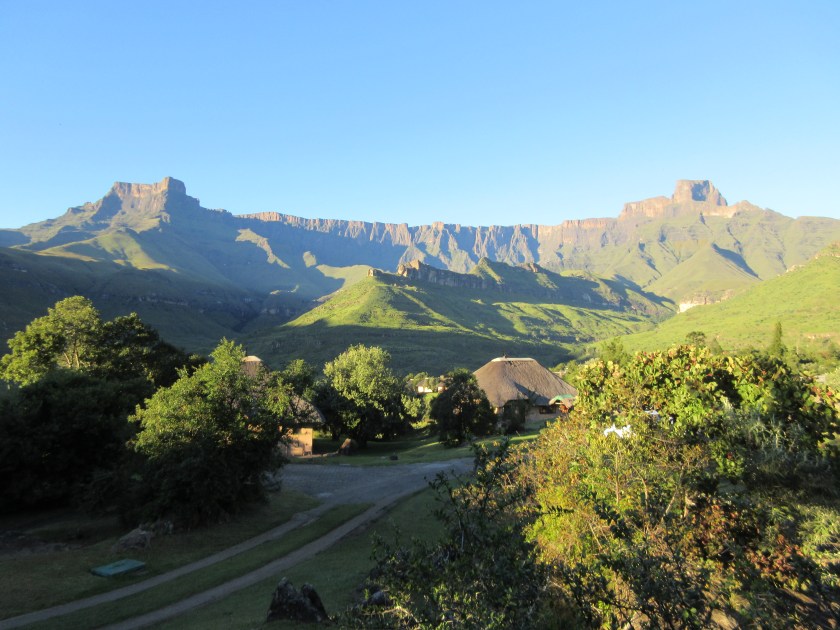
The Royal Natal National Park is notable for a beautiful physical feature called the Amphitheatre. The top of the Amphitheatre is the continental divide; water on one side flows to the Atlantic Ocean and on the other to the Indian Ocean. Our cabin faced the Amphitheatre and it was a treat to watch it change color in the morning and evening light. Three groups of baboons visited us one morning, peering through the windows in search of food.
 But we didn’t just sit around. We did a short hike to Tiger’s Falls that afternoon and then a day-long hike towards the Amphitheatre the next day. The longer hike ended up following the Tugela River. As it gets closer to the Amphitheatre, the river enters a narrow gorge, which eventually becomes a tunnel. Hiking through waist-deep water in a tunnel was more adventure than we had in mind and so we turned back. When a group of four people in their 20s also decided it was too much, we felt relieved. We weren’t complete wimps. It did feel strange to be hiking through a national park in Africa without a guide. In our two days at Royal Natal National Park, every one of the guests we saw was white and every staff person, ranger and house cleaner was black.
From there it was off to the Wild Coast. This was the longest day of driving of the trip. I had assumed that Lisa and I would be sharing the driving, but she didn’t bring her driver’s license and so it was all me behind he wheel. We left the N3 before Durban to cut off 100 kilometers and the city traffic. I took my ‘keep left’ mantra too far and the left front tire left the road. I tried to turn back onto the pavement, but the edge of the road was very rough from all the minivans pulling over to pick up and drop off passengers. The tire was flat, badly gouged in fact.
Some friendly locals offered to help and put on our spare. As we drove away, one man got upset that I’d given a tip to someone who hadn’t actually helped change the tire but just looked on. Unfortunately, the spare was not a full-sized tire, but a small ‘donut’ tire with a maximum speed of 80 kilometers. There was a major town, Kokstad, about an hour down the road. This was where we’d find the nearest tire store and so we headed off gingerly.
We hadn’t seen any white people as we drove through Kokstad looking for the tire store, but we pulled into the tire store’s parking lot to discover that most of its customers were white. Carrying the damaged tire, I headed to the counter with two white men behind it. A black employee intercepted me on the way. ‘They’re not the ones that are going to fix your tire, I am.’ We consulted and he went to work.
Eventually I wandered over to the counter to pay. The white men asked where we were heading. When I explained, they shook their heads. ‘That’s Transkei. Once you leave this valley, it’s like the wild west out there. Anything goes. On the road you’ll find potholes and cows and goats and ghosts. Be careful.’
I knew that Transkei was a region of South Africa, but didn’t know the history. Transkei was one of the Bantustans, black homelands, in apartheid South Africa. As usual, I didn’t quite know what to make of this latest security warning from white people, but assumed that it combined elements of truth and racist fear.
With our new tire in place, we headed on. We had a long way yet to go and made good time until we reached the towns. There the traffic crawled to a stop amidst of mass of humanity on foot and in cars. We squeezed through throngs of people shopping, selling, carrying. There was not a white person in sight and it felt like we were back in black Africa.
The last big town before our turn off the N2 for the Wild Coast was Mtatha. We rolled into town around 5:30 pm. We wondered if we should spend the night in Mtatha and finish the drive to Coffee Bay in the morning. We were going to do a two-day hike on the Wild Coast. I had the number for our guide, Isaac, in my phone and we were able to reach him. He said not to worry. ‘You won’t be car jacked and everything will be fine.’ So we decided to drove on.
The N2 makes a turn in town. With all the driving challenges and decision-making, we missed the sign. Looking at Google maps, Lisa noticed our error and that if we kept going straight we would run into the road to Coffee Bay below the N2. We decided to keep going forward on the side road as dusk settled.
About halfway to the road to Coffee Bay, with 20 kilometers to go, the pavement on our side road ended. Now we were bumping along a dirt road. Fog came in and so visibility was reduced further. Then night fell. Other than our headlights and the occasional other car, the blackness was total. I drove slowly as I had already blown one tire that day. We passed a man heading uphill on horseback and asked him if we were headed the right way. ‘Keep going straight. Keep going straight.’
A bakkie passed us, the back crammed full of women, presumably heading home after a day of work in town. The women were singing some beautiful transcendent tune. But even with their full load, they were moving faster than us and were soon out of sight and of earshot.
We finally reached the road to Coffee Bay. Despite its many pot holes, it was a welcome sight. And it had much more traffic on it, which was reassuring. We still had 60 kilometers to get to Coffee Bay and proceeded down the road for the coast.
By this point I had been driving on the wrong wide of the road for almost 13 hours that day. My attention wavered for a moment and I again wandered too far to the left and off the pavement. The tire wasn’t demolished like the first one, but flat nonetheless. I got out of the car and threw my hat on the ground in disgust.
Despite my frustration with myself, there was only one thing to do. I put fresh batteries in my headlamp and went to work putting the small spare back on the car. A few cars drove by, but no one walked past. 20 minutes later, our car was again moving down the road to Coffee Bay.
We drove more slowly now, both sets of eyes fully on the road to make sure I stayed on it and didn’t demolish our small spare on one of the many potholes. After 9:00 pm there were hardly any other cars on the road, which seemed to never end.
Finally, we arrived in Coffee Bay and at the end of a dirt road found our backpackers, the Coffee Shack. As we pulled into the one empty parking space, we could hear loud laughing and shouting. Some kind of drinking party was underway at the Coffee Shack. It seemed so incongruous given our experiences that day.
Gratefully, reception was still staffed. The woman gave Lisa a beer and me a Fanta Orange. I don’t know if this is standard practice or if she could tell we had been through an ordeal. The kitchen was closed for the night and so we shared a protein bar for dinner. But we didn’t mind the lack of hot food. We had reached the coast in one piece.
It turns out that our accommodation was on the Coffee Shack’s other property, a short walk but across a creek. They said we could carry our gear, but we chose to drive. This turned out to be a wise move. The creek crossing involves stepping carefully from stone to stone. It is not something we could do with our heavy bags. I know the locals seem to manage it effortlessly, but we were challenged by the crossing even in daylight without suitcases. We were finally settled into our room and were grateful when sleep took us.
We were heading off on a two-day hike up the coast to Lubanzi and then Bulungula the next morning. We woke to grey skies and steady rain. Our guide, Isaac, was due to meet us at the Coffee Shack at 10:30. The flat tire nagged at my attention. The nearest tire store was 100 kilometers away in Mtatha. But it was the Friday before Easter. In South Africa, there is a four-day national holiday at Easter from Friday through Monday. The tire stores in Mtatha wouldn’t be opening until Tuesday morning. By that time we planned to have spent three days on the coast and to have driven a couple of hundred kilometers further on the road to Cape Town.
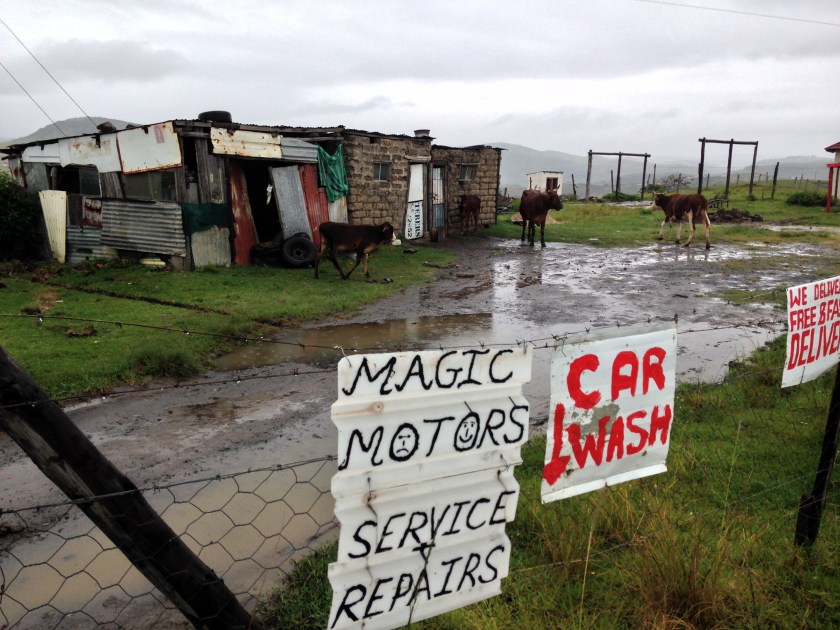 The folks at the Coffee Shack said that there was a guy in town who repaired tires. His shop was called Magic Motors. We drove there after breakfast in hopes he might be open and able to salvage our flat. His shop was a tin shack with cows and huge puddles of water in the yard. Parking the car I walked over in the rain. No one home. Looking at the place, maybe that was for the best. The flat tire would be a nagging distraction in the days ahead. Rather than just being focused on the beauty of the coast, I sometimes found myself worrying about how we would fix the tire.
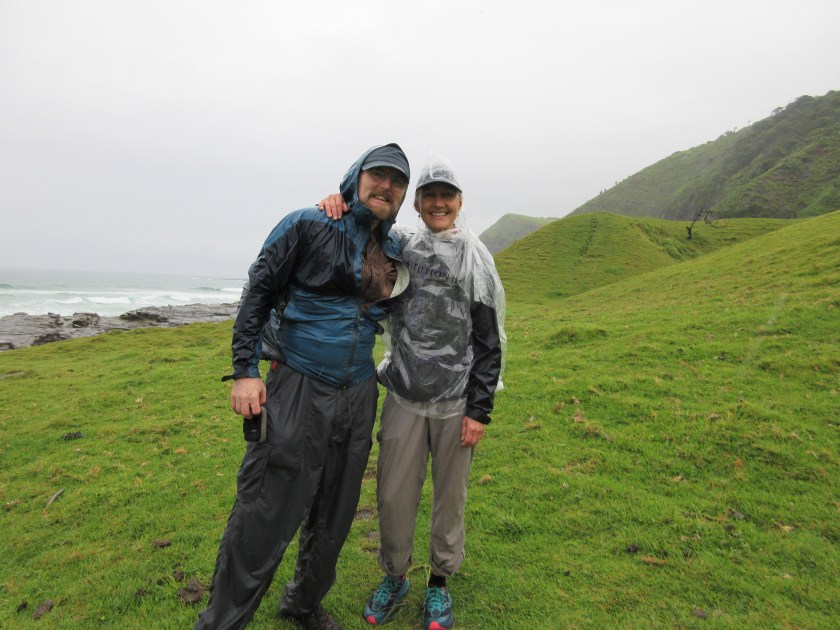 Back at the Coffee Shack, we met Isaac. He is 28 and his mother works at the Coffee Shack. He was wearing flip flips. His mother carved up three trash can liners for him to wear. We put on our fancy shoes and rain gear and headed off. It was the end of the rainy season and the hills were green. 2/3 of the way to Lubanzi was a natural feature called the Hole in the Wall. People went there as a regular day hike from Coffee Bay, but this day’s hike was certainly more adventure than we had planned.
The first part of the hike was on a narrow trail carved into a steep hillside above the ocean. One false step would probably have meant falling down the hillside and to your death in the ocean. I don’t mind short sections like this, but we were hiking on a trail like this for an hour or more—and in the rain. The concentration required for each step reminded me of the mental challenge of driving for hours on the wrong side of the road the day before. Gratefully, Lisa and I each had hiking poles and were ready to go as slow as needed. We were singing the Eagles ‘Take it to the Limit’ and found new meaning in the lyrics. Eventually we were past the steep hillside. The next section of the hike had more up and down, but at least we were on solid ground and a fall didn’t mean disaster.
Most of the way to Hole in the Wall, we came to a waterfall. Because of all the rain it surged with water and looked like Chocolate Falls from Willy Wonka’s factory. Isaac waded across just above the top of the falls, smiling back at us to show how safe it was. But the crossing was right at the top of the falls and one slip would have put us over the lip. We said no. So Isaac took us inland, for roads and a bridge.
I really enjoyed this part of the hike, as now we were hiking through a community where people lived. The Wild Coast is thick with people. There are households scattered over the hillsides for hundreds of kilometers. The people mostly lived in little rondavels, painted bright colors. It was great fun to be there with them, though I’m sure they thought we were crazy to be on this hike in the rain. Isaac’s mother called him several times to check and make sure we were OK.
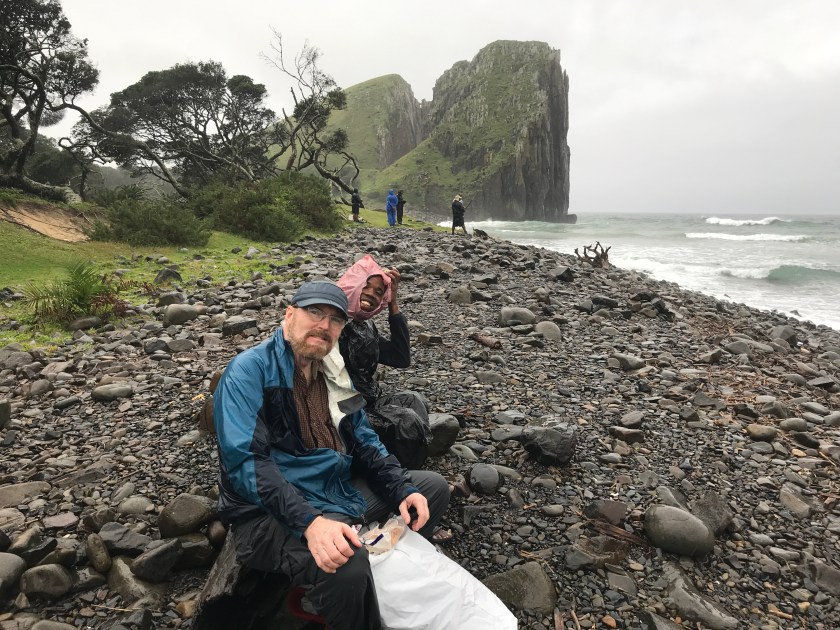 We climbed over one tall hill and came down to the Hole in the Wall. We sat in the rain eating cashews, drinking water, and looking at the hole.
Just past the Hole in the Wall was the other big river crossing of the day. We didn’t even take a look at it. I don’t know if Isaac decided it was too high due to the rain or decided that we weren’t up for a river crossing with water to our shoulders and our backpacks held over our heads. Had we crossed the river, apparently it was an easy hour hike from there to Lubanzi. Instead we walked inland again and huddled under the awning of a little shop, avoiding the rain. We were waiting for a bakkie, the local transit at this remote location.
After a brief wait, we climbed into the back of a bakkie and headed off. At first it was great fun. We enjoyed watching the interactions among the people in the vehicle and listening to them converse in Xhosa. We were in it. One woman had all the fixings for a big Easter party in the back—beer, soda, meat, etc. At one point they all started singing. They weren’t as good as the women the night before, but it was still beautiful.
But the ride went on and on and the thrill faded. We were hunched over and there was little fresh air. Forget seat belts. The woman with all the food asked if the bakkie would go out of its way to deliver the food to her place. Isaac bought a couple of beers and sat in the back sharing them with the other men. Then some drunk men got in. I started to get car sick and closed my eyes. Isaac kept saying ‘just three more minutes’ and ‘just one more minute.’ But the minutes kept ticking by and we still didn’t get there.
It was now 5:30 pm with darkness an hour away. Isaac said we had two more vehicle rides after this and then a walk to get Lubanzi. We knew we had accommodation at Wild Lubanzi. Had I ordered dinners? Isaac called Wild Lubanzi backpackers on Lisa’s phone—he was out of money on his. He got Rahel, the woman who runs Wild Lubanzi. Rahel said that she had to do a pick-up from the paved road and was at the spot where we were heading. She would wait for us.
We arrived at the main road and there was Rahel, cool as can be, waiting for us. She appeared like a rescuing angel. Instead of a chariot she had a four-wheel drive sedan. Some local men tried to cadge money for cigarettes as we figured out who would sit where. Our group let the car-sick fella have the front seat. We were on our way. Rahel had lived in Lubanzi for almost ten years. She knew every turn and each pothole. We careened down the mountain, but I felt confident that Rahel knew what she was doing. Rahel is a fascinating person and she and I had an interesting conversation all the way to Lubanzi.
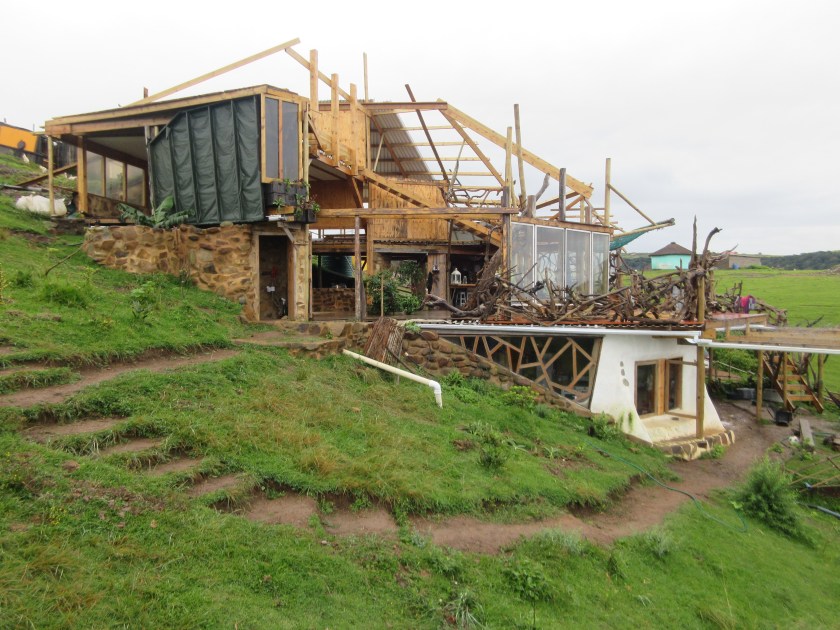 We arrived back at the coast as dusk we falling. We found a half-built lodge and, for us, a lovely tent overlooking the ocean. I know the locals ride the bakkies all the time, but I was so grateful that we got a ride here with Rahel and were able to skip two more rides on local transit and a walk in the dark.
Dinner was delicious and we ended up having another long conversation with Rahel. She is from Switzerland. ‘Everyone one there has all their material needs met, but so many people are depressed and unhappy.’ She drove from Switzerland to west Africa and somehow found her way to South Africa. She and Aidan, her South African husband, have been running a backpackers lodge in Lubanzi for seven years. She loves South Africa because there is still the ability to create something new there in a way that she doesn’t feel is possible in Switzerland.
Rahel also helped solve our car problem. She pointed out that there was an airport in Mtatha and that Hertz had an office. Airport car rental agencies would be open over the four-day Easter holiday.
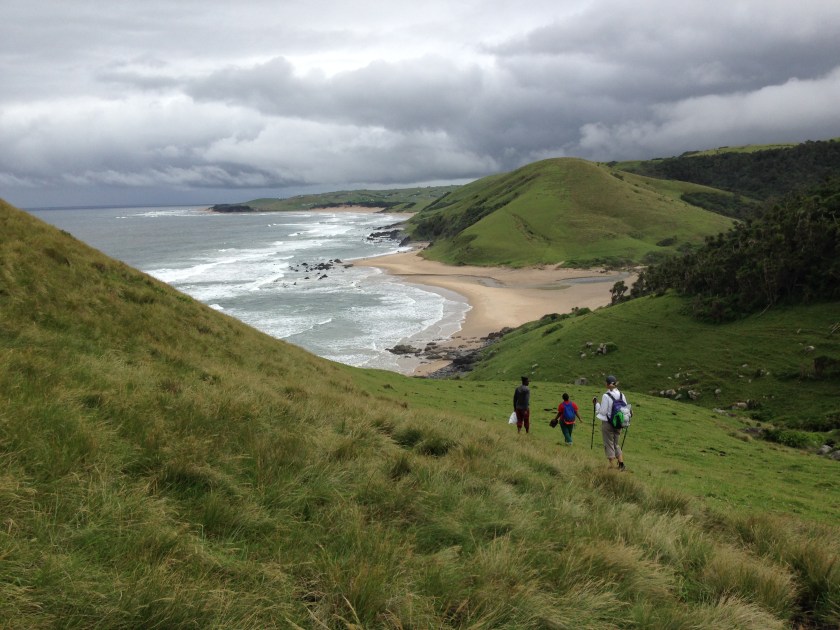 The next day there was no rain. The hike from Lubanzi to Bulungula only involved a couple of short exposed spots above the ocean. It was a beautiful walk.
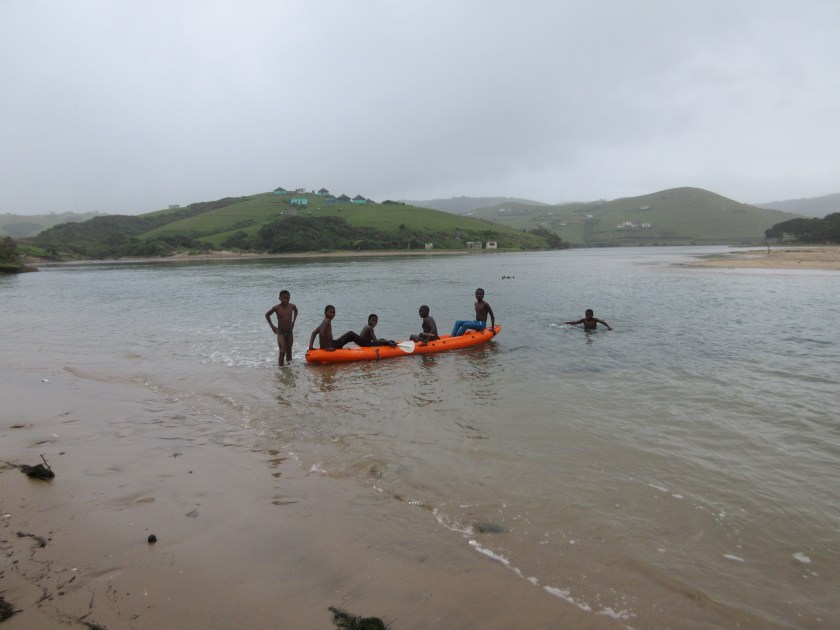
The only tricky water crossing was the river right in front of Bulungula Lodge, which was not passable at high tide. We arrived to find the water high. Isaac called out to some boys at a house on the other side and suddenly a kayak appeared. The five boys brought it to the lagoon and we used it to ferry us across. Our luck really had turned. We said good-bye and thanks to Isaac. He said I was the oldest person that he’d ever led on this hike. Then we finally got to relax and went for a long walk on the beach.
 We got the best cabin at Bulungula, the one closest to the lagoon. Coffee Bay has a whole litter of backpacker hostels and lodges. In Bulungula there is just the one lodge—at the end of a 40 kilometer dirt road. This is a community-run lodge where you can do all sorts of great cultural experiences. A group was heading off for a women’s empowerment walk the next morning when we left. Because this is a community run lodge in a rural area, there was no need for security. backing, There were no fences to keep out people—or goats and pigs. And not only were there no bars on the windows, but they had lost the key to our cabin and so we couldn’t even lock the door.
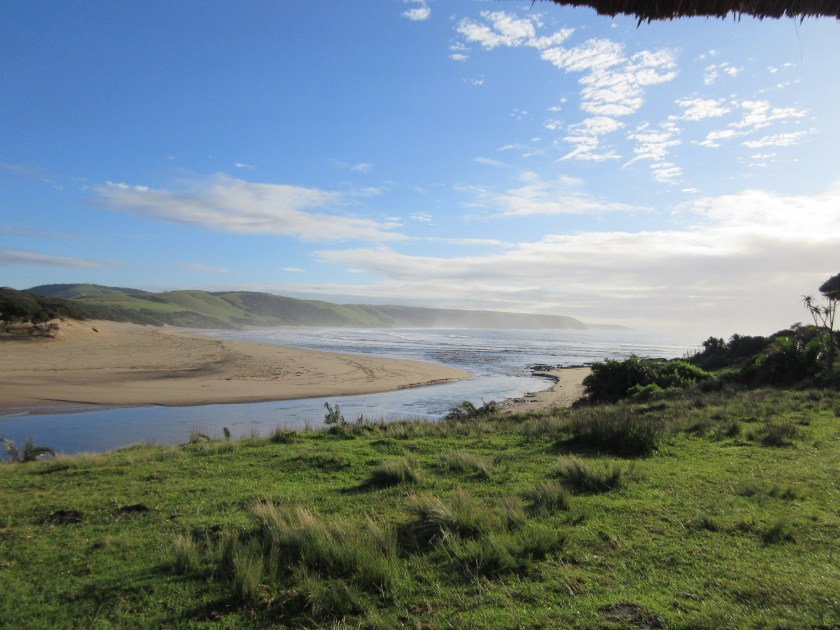 We were supposed to spend two nights at Bulungula, but even with four good tires we would have had to leave after one. Traveling here takes longer than I had figured on and we had to get back to the Coffee Shack to pick up our car. On the morning of Easter Sunday someone from Bulungula Lodge drove us the 40 kilometers on a dirt road to the main road to Coffee Bay. He was visibly relieved and proud when we made it to the main road. He helped us get a ride in a nice van and we rolled down to Coffee Bay.
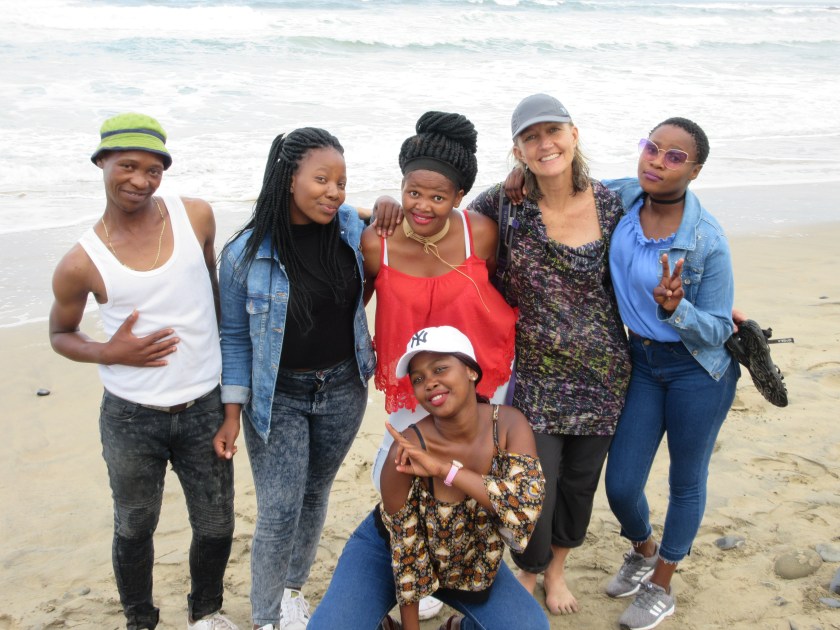
We weren’t in glorious Bulungula, but we still had fun in Coffee Bay on Easter Sunday. I called Hertz in Mtatha and he said he’d give us a new car tomorrow. Then we walked to a nearby beach, where lots of the locals were out celebrating. We went for a swim in the Indian Ocean and lay in the sun. Some of young adults were taking pictures. They asked if they could get pictures with us, so we asked if we could get pictures of us with them too.
 We ended the day by hiking up to an overlook where we could look down the coast to the start of our hike three days ago. We could just make out the trail cut into the side of the steep hill. Tomorrow was a 100 kilometer drive on a pothole filled road to Mtatha with no spare. We hoped for a little less adventure than we’d had in the previous days–and no rides in the back of a bakkie.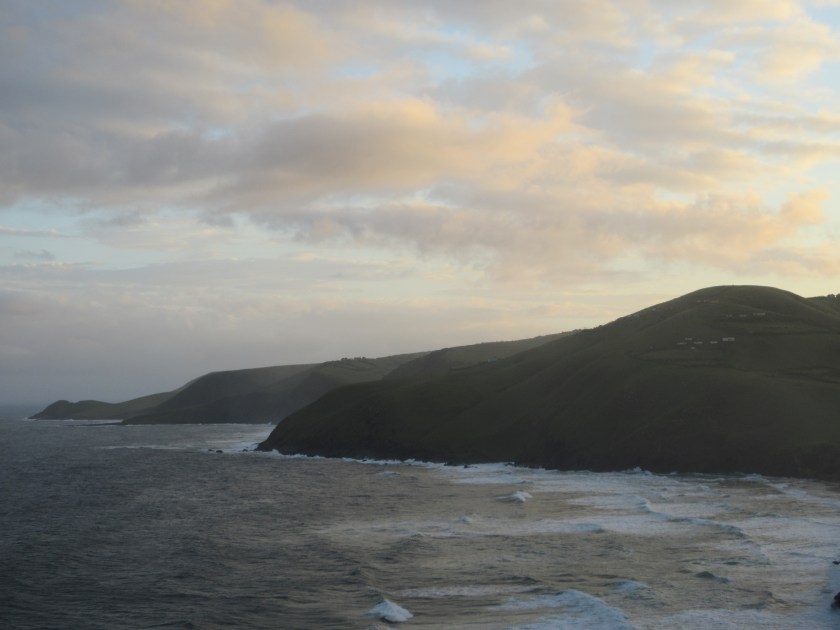
 No Foreign Lands
Super fun to read this since I was there!
Great conjuring up of our adventures together!
Love you!
L.
On Tue, Apr 10, 2018 at 1:46 PM, No Foreign Lands wrote:
> noforeignlands posted: “bakkie. Noun. 1. (South African) a small truck > with an open body and low sides A warm autumn evening in Cape Town. > Completely comfortable to sit outside, as I am now, without a jacket or > sweatshirt. The two waitresses at the burger place I’m gett” >
LikeLike
Wow! What an adventure! So wonderful to share this time with you, dear Marco, and so fun to read all about it here!
Love!
Lisa
LikeLike