On Sunday, Claire took me on a driving tour to learn about Vryburg. It’s a town of 48,000 people in the middle of South Africa’s cattle country. Under apartheid, every person was legally categorized by race and could only live in designated areas. It’s almost 25 years since the end of apartheid, but the divisions of apartheid still define the town.
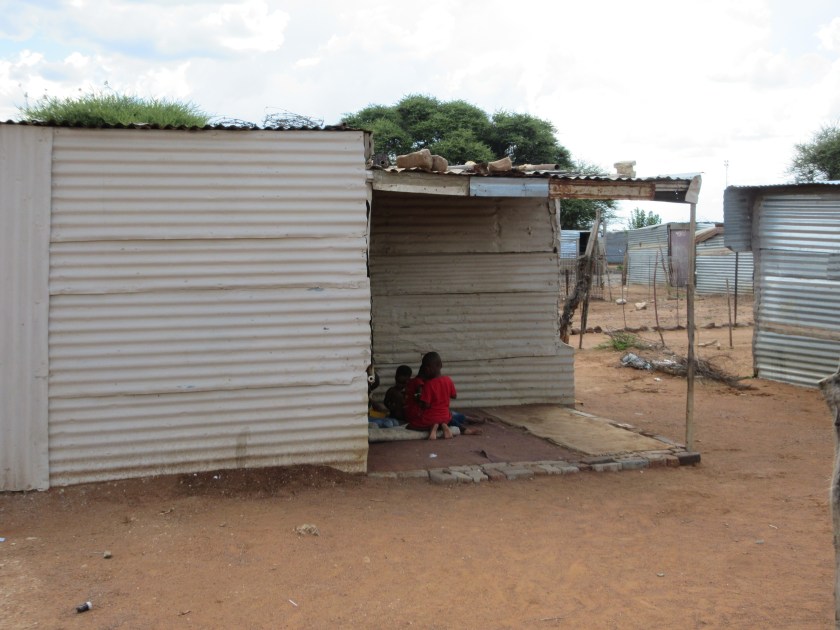
Under apartheid, blacks were not considered citizens of South Africa but of nine Bantustans that South Africa created. The areas where black Africans were allowed to live in ‘South Africa’ were called townships. We drove to the center of Vryburg and then Claire turned left off the main road. Within a block the town seemed to end and we came upon open fields. After a few hundred meters of fields we arrived at Huhudi, the black township. Huhudi went on for miles. There was the oldest section closest to town. Past it came row after row of tiny two-room government-built homes, constructed in different waves. The roads we drove on were all dirt. There is not a single school in Huhudi. The only stores or businesses we saw were a couple small tuck shops (a tiny convenience store with high prices). When we got to the far end of Huhudi, the structures became small shacks made out of aluminum. The population of the township is still entirely black African.
We next drove through Kismet, which is the ‘settlement’ or ‘location’ for people who were classified as Asian. In South Africa, Asian seems to mean Indian. Kismet is still 90% Indian, with some black and colored families having moved in. The homes were nice, and the streets were paved, but there is still a 100-meter barrier of open fields separating Kismet from town.
Then it was onto the colored area, Colridge. Claire didn’t know the origin of the name, but we couldn’t help but wonder if ‘colored’ is built into Colridge’s name. There was, again, still a section of open land separating this settlement from the rest of town. Like Kismet, the colored settlement had nice homes and paved streets. Colridge had several schools. On the far side of Colridge, there is a shanty town of aluminum-sided structures. This is the only place in Vryburg where there was a sharp contrast in adjacent neighborhoods.
I wanted to understand what ‘colored’ meant in South Africa today. Claire said that it was now more a cultural identity than a racial designation, that some people who identify as colored had one great grandparent who was white. I asked what it was about the ‘colored culture’ that identified it or would make people choose it, but Claire didn’t know.
Finally, we drove into ‘town.’ This is the former white section of Vryburg. Apparently, no whites have moved to other sections of Vryburg, but other people have moved into and somewhat integrated the town.
I titled this entry ‘Visible Scars’ but wonder if ‘Open Wounds’ would have been more accurate.


I’m loving reading your blog, Mark ~ please give my regards to Claire!
LikeLike