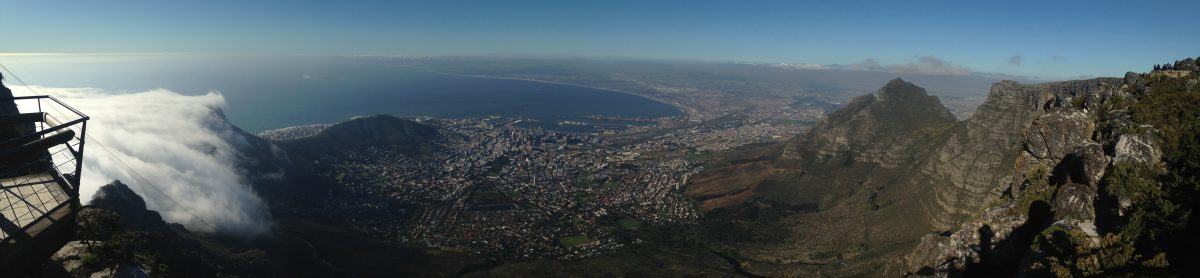
Sitting at a café in Cape Town gazing up at Table Mountain. Getting nostalgic for South Africa. On Saturday, in two days, I fly to Jo ’burg and London, ending my sojourn in southern Africa.
All the customers and the seeming owner of the café are white. The waiter and cook are black. A black man stands outside the café walking around selling brooms, mops and spoons. Another black man wears a yellow vest, hoping for tips from watching people’s cars while they shop. A white woman drives by in a bakkie with two black man in back. Laborers she hired?
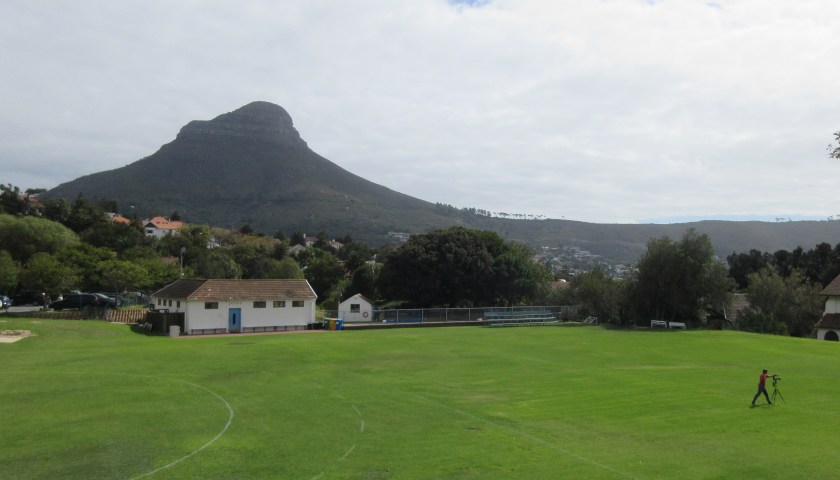
View across St. Cyprian’s School sports field at Lions Head.
I visited St. Cyprian’s School today. It’s in the central city bowl, in the ‘up market’ neighborhood on the slopes of Table Mountain, and so I walked there from my hotel. Hiking there seemed the way to go in part because I wasn’t sure I could get an Uber during rush hour. Almost all South African bus drivers are on strike nationwide. On the hike to school I passed two almost empty water reservoirs.
Dining room door in old manor house at St. Cyprian’s School. The floors are beautiful local yellowwood. The slaves lived in the basement underneath.
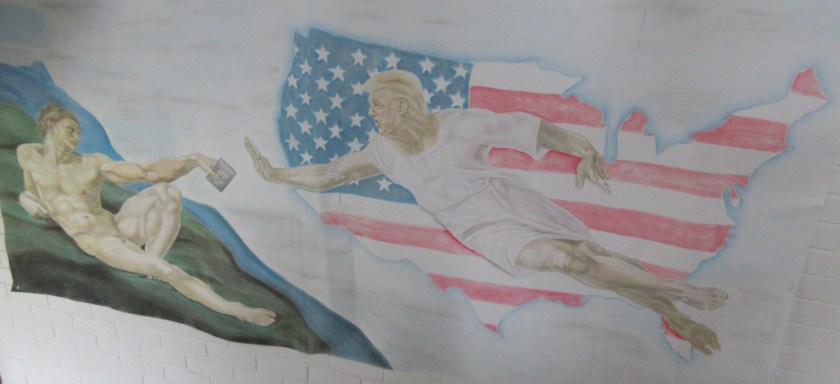
My friend, Dave Carr, gave me a tour of the campus. In the art building, there is a large drawing by the student that uses the images from the Sistine Chapel to comment on Trump’s immigration policies. St. Cyprians is located on what was an once a wheat farm. The school’s administration works out of the old manor house. The owner’s family lived on the first and second floor and the slaves lived in the basement.
Artwork done by student at St. Cyprian’s School
I met with the students on the school’s leadership team for Round Square, an international network of schools. Dave Carr, the Round Square coordinator, does a great job developing student leaders. It was fun to be interacting with a smart passionate group of young people.
I asked the girls to introduce themselves and tell me their favorite Round Square activity or what they most appreciated about Round Square. Most of the girls had been on multiple international adventures with Round Square. The one black girl in the group was among the last students to talk. She spoke articulately about what she liked about Round Square; however, alone among the group, she hasn’t been on an international trip.
The English class I sat in on was reading Americnah by Chimamanda Ngozi Adichie. The students read her novel Half of a Yellow Sun last year and some of them even read her book Purple Hibiscus for another class. One of the students criticized Americanah for being too oriented to Western readers as opposed to African readers.
I also sat in a history class. The classroom walls were covered with posters and photographs and quotes. Many of the people and images were from the United States: Maya Angelou, Diana Nash, Fannie Lou Hamer, Martin Luther King, “We Can Do It.” The person who appeared most frequently was Angela Davis. I told the teacher that I had organized a Round Square conference a few years ago and we had Angela Davis as a keynote speaker. She swooned with envy.
The class was about the French Revolution. The repeal of the Edict of Nantes sent 400,000 French Protestants (the Huguenots) out of France. Some of them came to South Africa and founded Franschhoek (‘French corner’), the place I was the last few days, and the first South African wineries. At the time of the revolution, over half the French government’s budget was going to debt service for wars. The most recent war that the French peasants and merchants were paying for—the Catholic Church and nobles being untaxed–was France’s involvement in the ‘American war of independence.’
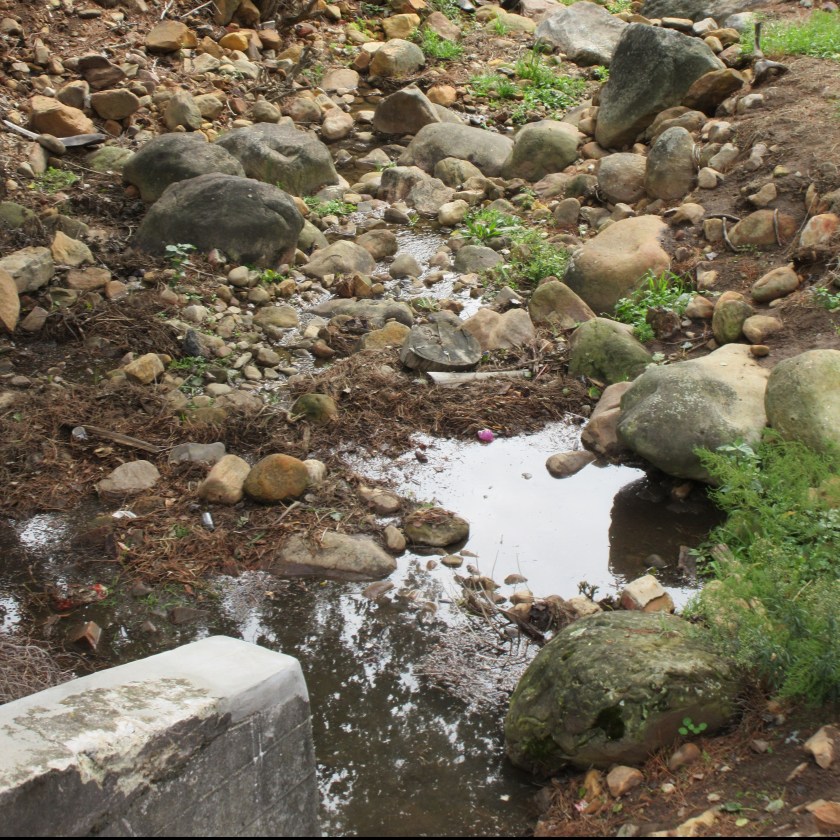
Dave and I walked to a nearby restaurant for lunch. To get there we had to cross a stream coming down off Table Mountain. It had running water in it from yesterday’s showers. Dave couldn’t remember the last time he had seen water flowing in this creek.
As the clock turns past three, traffic outside the café picks up, both in the number of cars and the number of pedestrians. The pedestrians are almost all black people walking downhill, presumably heading home after a day working at the homes of well-to-do families living on the slopes of Table Mountain.
The man with the mops and brooms stands by the side of the road, hoping for a sale. I can’t carry a broom to the UK, Jordan and back to California. I do think I can squeeze a wooden spoon into my luggage, so I’m off to buy one.
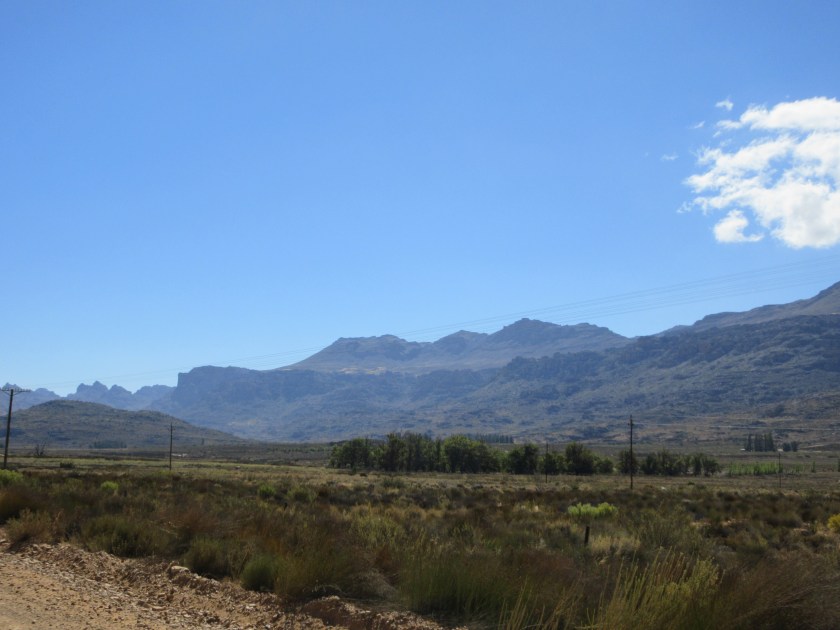
My last night in the Cederberg Wilderness. The stars are brilliant on a black moonless sky. The Milky Way is directly overhead, a faint wash of white. The stillness outside seems complete. I can’t detect any sound. No birds or insects or animals. No wind or rustling tree branches. No moving water. No human voices or machines. The only sound I can find is a buzz in my own head, like the hum of a machine that is rarely noticed.
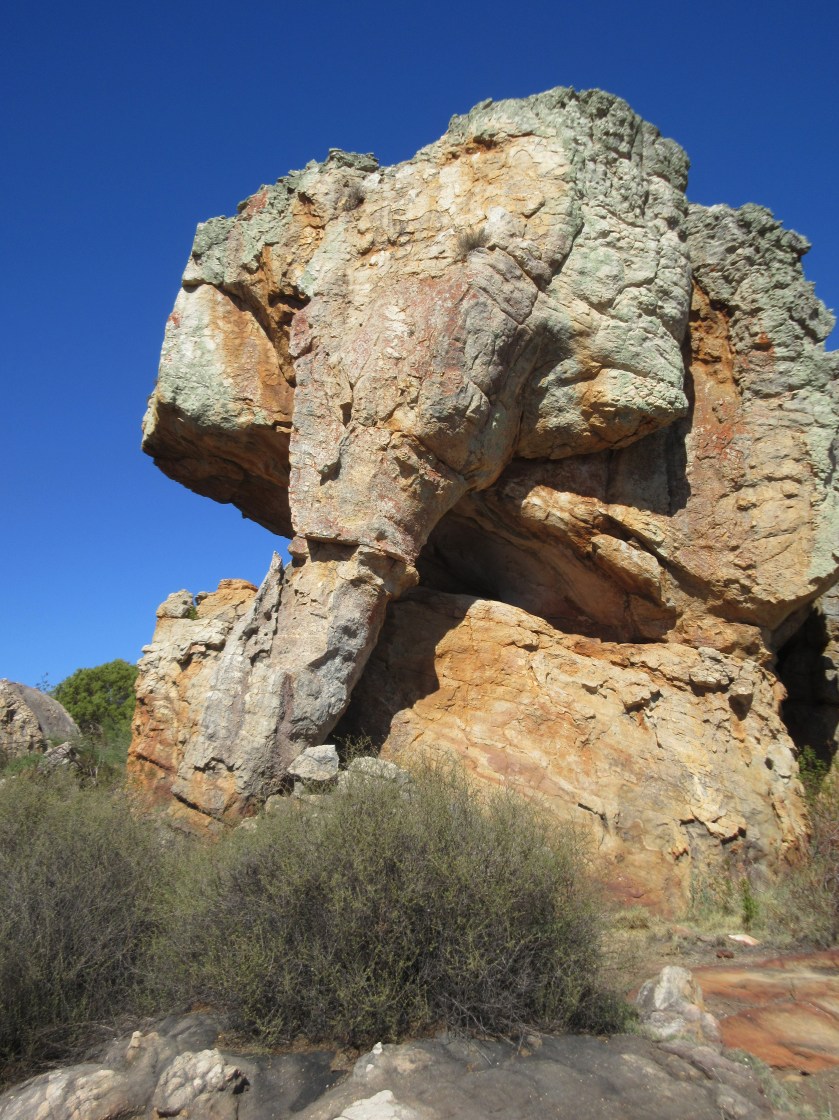
I went for a walk today from the lodge—another flat tire yesterday meant no driving today as I couldn’t risk the latest undersized spare on the dirt roads of Cederberg–and encountered a similar silence mid-day. The lack of noise is both calming and slightly eerie. This is a semi-arid region of brush and tiny flowers. Rooibos, of Rooibos tea fame, grows here. The destination for my hike was a rock formation that resembled an elephant. Rock elephants do not make trumpeting calls.
Tonight, a couple from Cape Town and I were guided up Leopard’s Rock, which sits prominently just below my cabin here at Gecko Creek Wilderness Lodge. We saw some San paintings under a rock overhanging. The paintings were made 7,000 to 20,000 years ago with the blood of animals. We saw the blackened wall where the San lit their fire. I thought about their lives here, on this spot on the planet. They were a nomadic people. I am in a nomadic phase. Will I ever return to this rock?
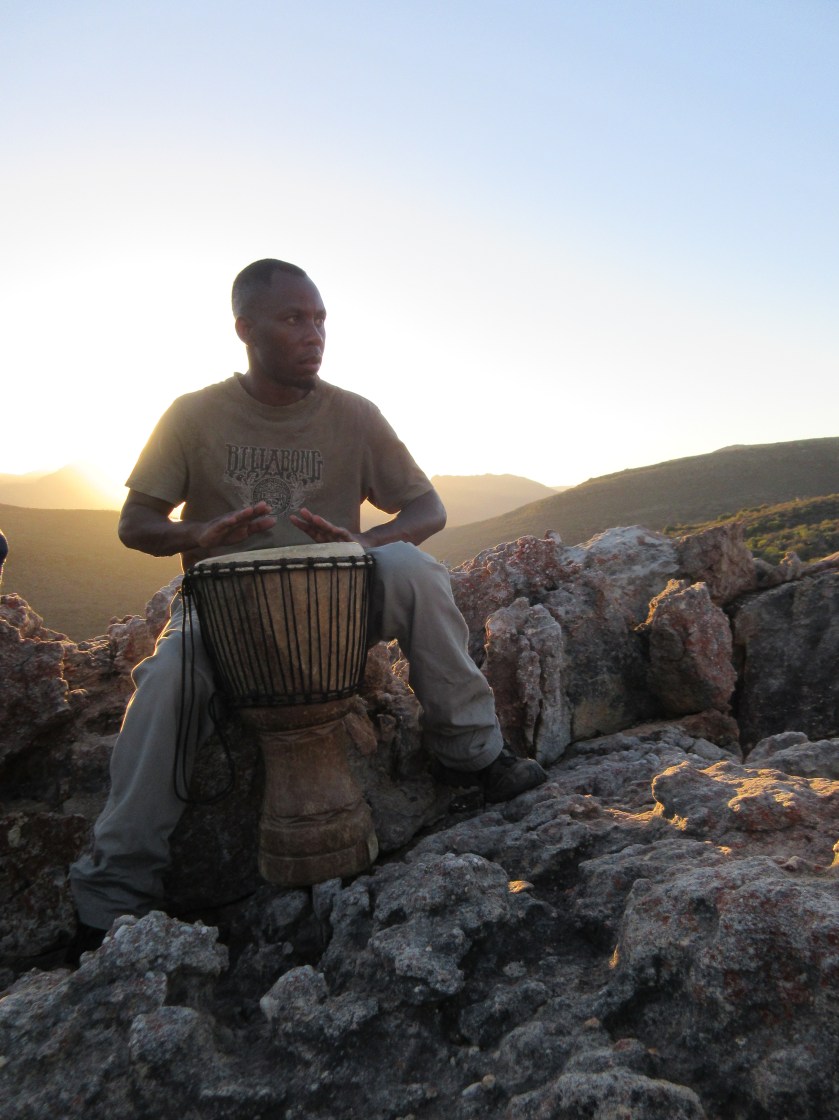
After seeing the paintings, the four of us climbed to the top of the rock outcropping, a climb that was more adventurous than a lodge in the USA would have allowed. At the top, we asked Ferai, our guide, questions about the San people and his own life. Ferai brought a drum and we drummed the sun down over the mountains.
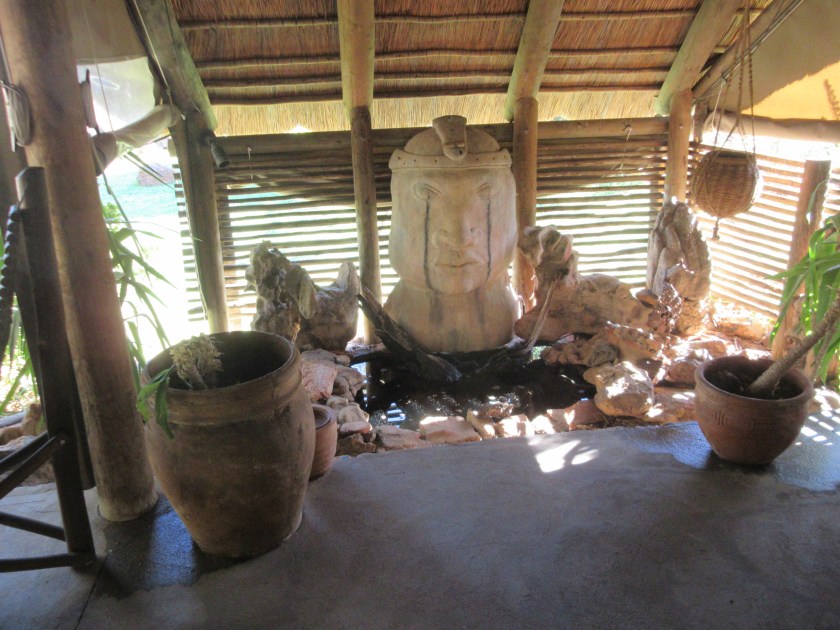
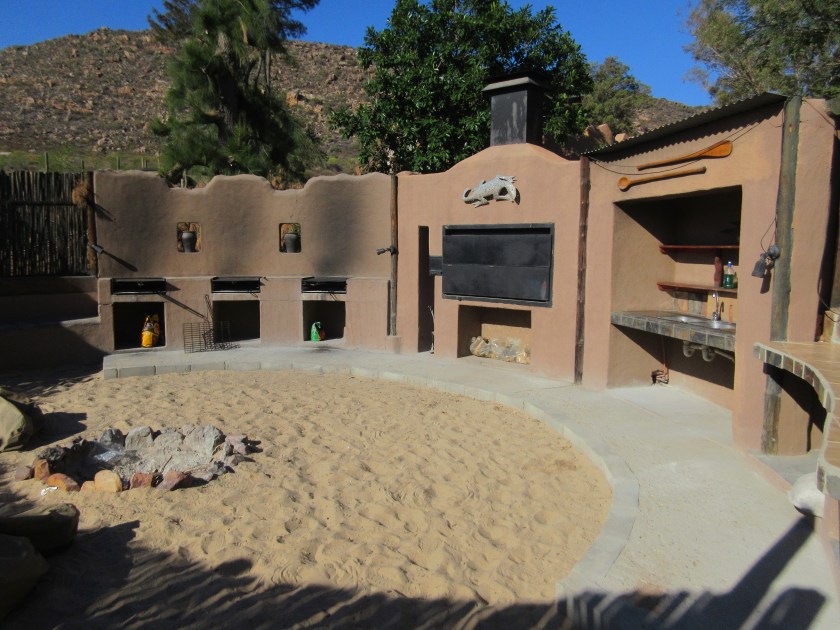
Gecko Creek has a braai area that seems designed like a temple. Most of the South African couples and families headed there to cook their dinner. Braai is not the South Africa word for Bar-B-Q. For South Africans—and maybe this is white Africaan’s South Africans—the braai is an important aspect of their culture. Each home I’ve visited has a place to braai outside. Not a portable grill, but a permanent structure. They prefer to braai with wood, though charcoal is acceptable. An Africaans man here scoffed when I said that most of the grilling I do in California is on a gas grill.
Growing up, my family had steak two to three nights a week and it was always grilled outside. For five years, from eighth grade till I left for college, I stood over the Weber grill in all seasons. In short, I have a lot of experience cooking meat over a flame, but I felt like a child last night being shown the proper way to braai by an Africaans man. ‘Here’s how to light the coals.’ ‘You should start to heat the grill now.’ ‘You need to let the coals burn a little longer before starting to cook the meat.’ He was aghast that I was cooking both last night’s dinner and the chicken for tonight’s salad, rather than having another braai tonight.
He started his coals before me, but I was finished eating my meal before he and his wife started theirs. Efficiency is not part of the braai experience.
In addition to the cooking fires, tonight a social fire was lit in the middle of the braai area. Two married South African couples told touching stories about how they met. One of them was a love-at-first-sight tale where they half-jokingly said they should get married in their first conversation—and decided for real within days! The man is from Saint Helena, an island in the middle of the Atlantic that is a five-day boat ride from Cape Town. Their lives have changed because there is now a once-a-week plane from Jo’burg. The other involves an Africaans woman and an English-speaking man. The friends of the Africaans woman were shocked.
Sitting under the stars and around the fire, we talked, first about how they met, then about why Cape Town is better than Jo‘burg, then about crime and gun violence and Zuma and Trump and why Oscar Pretorius did it. Talking with these friendly strangers, the world’s problems seemed far away.
I leave South Africa a week from today and fly back to California in a little over a month. There is still a LOT between here and home, but the road ahead no longer seems endless. And so I linger a moment longer at the stars and listen for sounds I cannot hear.
bakkie. Noun. 1. (South African) a small truck with an open body and low sides
A warm autumn evening in Cape Town. Completely comfortable to sit outside, as I am now, without a jacket or sweatshirt. The two waitresses at the burger place I’m getting dinner are both white and have blonde hair.
Lisa, my wife, was here for the last two weeks. Now she is on a plane to London. It was fun to travel with her. To see her fall in love with the people and place—and to watch people fall in love with her. To see her reconnect her with her traveling self, a side that was prominent in her 20s. After ten weeks on my own, it was also different to travel with another person. And it didn’t leave any time for writing blog entries.
Lisa arrived in Johannesburg 14 days ago. We did Jo’ burg in a day: Apartheid Museum, walking tour of Soweto, Nelson Mandela Square. We passed Winnie Mandela’s house in Soweto. She died a couple of days ago and the flags in South Africa all fly at half-mast.
The bed-and-breakfast where we stayed is located in Johannesburg’s Jewish neighborhood. We were only there one day but saw many Jews walking around and shopping at the local Pick n Pay (which had not one but two sections of Kosher food). Our hosts were Jewish and the rabbi even came to visit them one day. It felt different—and nice–to be in South Africa amongst white people who were Jewish. Though like all of thethe northern suburbs of Jo’burg, the streets are kilometer after kilometer of walls with an occasional retail district mixed in.
We drove from Johannesburg to Cape Town over the course of ten days. Lisa’s first full day in South Africa we headed south on the N3 in our rental car for Drakensberg (mountains of dragons). For three hours we passed huge agricultural fields with barely a farm in sight. There were also beautiful red and white cosmos (not native to South Africa) in bloom alongside the road.
View of the Ampitheatre from our cabin in the Royal Natal National Park
The Royal Natal National Park is notable for a beautiful physical feature called the Amphitheatre. The top of the Amphitheatre is the continental divide; water on one side flows to the Atlantic Ocean and on the other to the Indian Ocean. Our cabin faced the Amphitheatre and it was a treat to watch it change color in the morning and evening light. Three groups of baboons visited us one morning, peering through the windows in search of food.
But we didn’t just sit around. We did a short hike to Tiger’s Falls that afternoon and then a day-long hike towards the Amphitheatre the next day. The longer hike ended up following the Tugela River. As it gets closer to the Amphitheatre, the river enters a narrow gorge, which eventually becomes a tunnel. Hiking through waist-deep water in a tunnel was more adventure than we had in mind and so we turned back. When a group of four people in their 20s also decided it was too much, we felt relieved. We weren’t complete wimps. It did feel strange to be hiking through a national park in Africa without a guide. In our two days at Royal Natal National Park, every one of the guests we saw was white and every staff person, ranger and house cleaner was black.
From there it was off to the Wild Coast. This was the longest day of driving of the trip. I had assumed that Lisa and I would be sharing the driving, but she didn’t bring her driver’s license and so it was all me behind he wheel. We left the N3 before Durban to cut off 100 kilometers and the city traffic. I took my ‘keep left’ mantra too far and the left front tire left the road. I tried to turn back onto the pavement, but the edge of the road was very rough from all the minivans pulling over to pick up and drop off passengers. The tire was flat, badly gouged in fact.
Some friendly locals offered to help and put on our spare. As we drove away, one man got upset that I’d given a tip to someone who hadn’t actually helped change the tire but just looked on. Unfortunately, the spare was not a full-sized tire, but a small ‘donut’ tire with a maximum speed of 80 kilometers. There was a major town, Kokstad, about an hour down the road. This was where we’d find the nearest tire store and so we headed off gingerly.
We hadn’t seen any white people as we drove through Kokstad looking for the tire store, but we pulled into the tire store’s parking lot to discover that most of its customers were white. Carrying the damaged tire, I headed to the counter with two white men behind it. A black employee intercepted me on the way. ‘They’re not the ones that are going to fix your tire, I am.’ We consulted and he went to work.
Eventually I wandered over to the counter to pay. The white men asked where we were heading. When I explained, they shook their heads. ‘That’s Transkei. Once you leave this valley, it’s like the wild west out there. Anything goes. On the road you’ll find potholes and cows and goats and ghosts. Be careful.’
I knew that Transkei was a region of South Africa, but didn’t know the history. Transkei was one of the Bantustans, black homelands, in apartheid South Africa. As usual, I didn’t quite know what to make of this latest security warning from white people, but assumed that it combined elements of truth and racist fear.
With our new tire in place, we headed on. We had a long way yet to go and made good time until we reached the towns. There the traffic crawled to a stop amidst of mass of humanity on foot and in cars. We squeezed through throngs of people shopping, selling, carrying. There was not a white person in sight and it felt like we were back in black Africa.
The last big town before our turn off the N2 for the Wild Coast was Mtatha. We rolled into town around 5:30 pm. We wondered if we should spend the night in Mtatha and finish the drive to Coffee Bay in the morning. We were going to do a two-day hike on the Wild Coast. I had the number for our guide, Isaac, in my phone and we were able to reach him. He said not to worry. ‘You won’t be car jacked and everything will be fine.’ So we decided to drove on.
The N2 makes a turn in town. With all the driving challenges and decision-making, we missed the sign. Looking at Google maps, Lisa noticed our error and that if we kept going straight we would run into the road to Coffee Bay below the N2. We decided to keep going forward on the side road as dusk settled.
About halfway to the road to Coffee Bay, with 20 kilometers to go, the pavement on our side road ended. Now we were bumping along a dirt road. Fog came in and so visibility was reduced further. Then night fell. Other than our headlights and the occasional other car, the blackness was total. I drove slowly as I had already blown one tire that day. We passed a man heading uphill on horseback and asked him if we were headed the right way. ‘Keep going straight. Keep going straight.’
A bakkie passed us, the back crammed full of women, presumably heading home after a day of work in town. The women were singing some beautiful transcendent tune. But even with their full load, they were moving faster than us and were soon out of sight and of earshot.
We finally reached the road to Coffee Bay. Despite its many pot holes, it was a welcome sight. And it had much more traffic on it, which was reassuring. We still had 60 kilometers to get to Coffee Bay and proceeded down the road for the coast.
By this point I had been driving on the wrong wide of the road for almost 13 hours that day. My attention wavered for a moment and I again wandered too far to the left and off the pavement. The tire wasn’t demolished like the first one, but flat nonetheless. I got out of the car and threw my hat on the ground in disgust.
Despite my frustration with myself, there was only one thing to do. I put fresh batteries in my headlamp and went to work putting the small spare back on the car. A few cars drove by, but no one walked past. 20 minutes later, our car was again moving down the road to Coffee Bay.
We drove more slowly now, both sets of eyes fully on the road to make sure I stayed on it and didn’t demolish our small spare on one of the many potholes. After 9:00 pm there were hardly any other cars on the road, which seemed to never end.
Finally, we arrived in Coffee Bay and at the end of a dirt road found our backpackers, the Coffee Shack. As we pulled into the one empty parking space, we could hear loud laughing and shouting. Some kind of drinking party was underway at the Coffee Shack. It seemed so incongruous given our experiences that day.
Gratefully, reception was still staffed. The woman gave Lisa a beer and me a Fanta Orange. I don’t know if this is standard practice or if she could tell we had been through an ordeal. The kitchen was closed for the night and so we shared a protein bar for dinner. But we didn’t mind the lack of hot food. We had reached the coast in one piece.
It turns out that our accommodation was on the Coffee Shack’s other property, a short walk but across a creek. They said we could carry our gear, but we chose to drive. This turned out to be a wise move. The creek crossing involves stepping carefully from stone to stone. It is not something we could do with our heavy bags. I know the locals seem to manage it effortlessly, but we were challenged by the crossing even in daylight without suitcases. We were finally settled into our room and were grateful when sleep took us.
We were heading off on a two-day hike up the coast to Lubanzi and then Bulungula the next morning. We woke to grey skies and steady rain. Our guide, Isaac, was due to meet us at the Coffee Shack at 10:30. The flat tire nagged at my attention. The nearest tire store was 100 kilometers away in Mtatha. But it was the Friday before Easter. In South Africa, there is a four-day national holiday at Easter from Friday through Monday. The tire stores in Mtatha wouldn’t be opening until Tuesday morning. By that time we planned to have spent three days on the coast and to have driven a couple of hundred kilometers further on the road to Cape Town.
The folks at the Coffee Shack said that there was a guy in town who repaired tires. His shop was called Magic Motors. We drove there after breakfast in hopes he might be open and able to salvage our flat. His shop was a tin shack with cows and huge puddles of water in the yard. Parking the car I walked over in the rain. No one home. Looking at the place, maybe that was for the best. The flat tire would be a nagging distraction in the days ahead. Rather than just being focused on the beauty of the coast, I sometimes found myself worrying about how we would fix the tire.
Back at the Coffee Shack, we met Isaac. He is 28 and his mother works at the Coffee Shack. He was wearing flip flips. His mother carved up three trash can liners for him to wear. We put on our fancy shoes and rain gear and headed off. It was the end of the rainy season and the hills were green. 2/3 of the way to Lubanzi was a natural feature called the Hole in the Wall. People went there as a regular day hike from Coffee Bay, but this day’s hike was certainly more adventure than we had planned.
The first part of the hike was on a narrow trail carved into a steep hillside above the ocean. One false step would probably have meant falling down the hillside and to your death in the ocean. I don’t mind short sections like this, but we were hiking on a trail like this for an hour or more—and in the rain. The concentration required for each step reminded me of the mental challenge of driving for hours on the wrong side of the road the day before. Gratefully, Lisa and I each had hiking poles and were ready to go as slow as needed. We were singing the Eagles ‘Take it to the Limit’ and found new meaning in the lyrics. Eventually we were past the steep hillside. The next section of the hike had more up and down, but at least we were on solid ground and a fall didn’t mean disaster.
Most of the way to Hole in the Wall, we came to a waterfall. Because of all the rain it surged with water and looked like Chocolate Falls from Willy Wonka’s factory. Isaac waded across just above the top of the falls, smiling back at us to show how safe it was. But the crossing was right at the top of the falls and one slip would have put us over the lip. We said no. So Isaac took us inland, for roads and a bridge.
I really enjoyed this part of the hike, as now we were hiking through a community where people lived. The Wild Coast is thick with people. There are households scattered over the hillsides for hundreds of kilometers. The people mostly lived in little rondavels, painted bright colors. It was great fun to be there with them, though I’m sure they thought we were crazy to be on this hike in the rain. Isaac’s mother called him several times to check and make sure we were OK.
We climbed over one tall hill and came down to the Hole in the Wall. We sat in the rain eating cashews, drinking water, and looking at the hole.
Just past the Hole in the Wall was the other big river crossing of the day. We didn’t even take a look at it. I don’t know if Isaac decided it was too high due to the rain or decided that we weren’t up for a river crossing with water to our shoulders and our backpacks held over our heads. Had we crossed the river, apparently it was an easy hour hike from there to Lubanzi. Instead we walked inland again and huddled under the awning of a little shop, avoiding the rain. We were waiting for a bakkie, the local transit at this remote location.
After a brief wait, we climbed into the back of a bakkie and headed off. At first it was great fun. We enjoyed watching the interactions among the people in the vehicle and listening to them converse in Xhosa. We were in it. One woman had all the fixings for a big Easter party in the back—beer, soda, meat, etc. At one point they all started singing. They weren’t as good as the women the night before, but it was still beautiful.
But the ride went on and on and the thrill faded. We were hunched over and there was little fresh air. Forget seat belts. The woman with all the food asked if the bakkie would go out of its way to deliver the food to her place. Isaac bought a couple of beers and sat in the back sharing them with the other men. Then some drunk men got in. I started to get car sick and closed my eyes. Isaac kept saying ‘just three more minutes’ and ‘just one more minute.’ But the minutes kept ticking by and we still didn’t get there.
It was now 5:30 pm with darkness an hour away. Isaac said we had two more vehicle rides after this and then a walk to get Lubanzi. We knew we had accommodation at Wild Lubanzi. Had I ordered dinners? Isaac called Wild Lubanzi backpackers on Lisa’s phone—he was out of money on his. He got Rahel, the woman who runs Wild Lubanzi. Rahel said that she had to do a pick-up from the paved road and was at the spot where we were heading. She would wait for us.
Aidan and Rahel of Wild Lubanzi
We arrived at the main road and there was Rahel, cool as can be, waiting for us. She appeared like a rescuing angel. Instead of a chariot she had a four-wheel drive sedan. Some local men tried to cadge money for cigarettes as we figured out who would sit where. Our group let the car-sick fella have the front seat. We were on our way. Rahel had lived in Lubanzi for almost ten years. She knew every turn and each pothole. We careened down the mountain, but I felt confident that Rahel knew what she was doing. Rahel is a fascinating person and she and I had an interesting conversation all the way to Lubanzi.
We arrived back at the coast as dusk we falling. We found a half-built lodge and, for us, a lovely tent overlooking the ocean. I know the locals ride the bakkies all the time, but I was so grateful that we got a ride here with Rahel and were able to skip two more rides on local transit and a walk in the dark.
Dinner was delicious and we ended up having another long conversation with Rahel. She is from Switzerland. ‘Everyone one there has all their material needs met, but so many people are depressed and unhappy.’ She drove from Switzerland to west Africa and somehow found her way to South Africa. She and Aidan, her South African husband, have been running a backpackers lodge in Lubanzi for seven years. She loves South Africa because there is still the ability to create something new there in a way that she doesn’t feel is possible in Switzerland.
Rahel also helped solve our car problem. She pointed out that there was an airport in Mtatha and that Hertz had an office. Airport car rental agencies would be open over the four-day Easter holiday.
The next day there was no rain. The hike from Lubanzi to Bulungula only involved a couple of short exposed spots above the ocean. It was a beautiful walk.
The only tricky water crossing was the river right in front of Bulungula Lodge, which was not passable at high tide. We arrived to find the water high. Isaac called out to some boys at a house on the other side and suddenly a kayak appeared. The five boys brought it to the lagoon and we used it to ferry us across. Our luck really had turned. We said good-bye and thanks to Isaac. He said I was the oldest person that he’d ever led on this hike. Then we finally got to relax and went for a long walk on the beach.
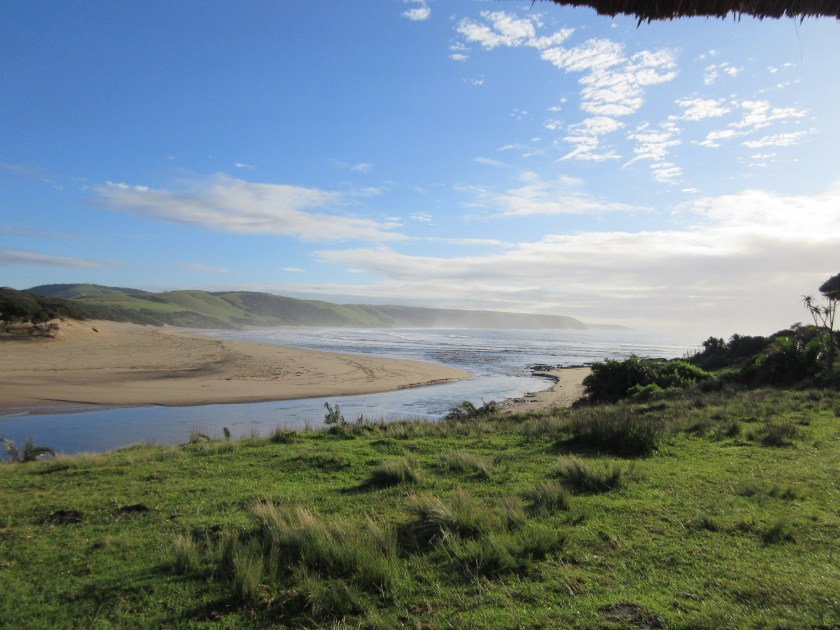
We got the best cabin at Bulungula, the one closest to the lagoon. Coffee Bay has a whole litter of backpacker hostels and lodges. In Bulungula there is just the one lodge—at the end of a 40 kilometer dirt road. This is a community-run lodge where you can do all sorts of great cultural experiences. A group was heading off for a women’s empowerment walk the next morning when we left. Because this is a community run lodge in a rural area, there was no need for security. backing, There were no fences to keep out people—or goats and pigs. And not only were there no bars on the windows, but they had lost the key to our cabin and so we couldn’t even lock the door.
We were supposed to spend two nights at Bulungula, but even with four good tires we would have had to leave after one. Traveling here takes longer than I had figured on and we had to get back to the Coffee Shack to pick up our car. On the morning of Easter Sunday someone from Bulungula Lodge drove us the 40 kilometers on a dirt road to the main road to Coffee Bay. He was visibly relieved and proud when we made it to the main road. He helped us get a ride in a nice van and we rolled down to Coffee Bay.
We weren’t in glorious Bulungula, but we still had fun in Coffee Bay on Easter Sunday. I called Hertz in Mtatha and he said he’d give us a new car tomorrow. Then we walked to a nearby beach, where lots of the locals were out celebrating. We went for a swim in the Indian Ocean and lay in the sun. Some of young adults were taking pictures. They asked if they could get pictures with us, so we asked if we could get pictures of us with them too.
We ended the day by hiking up to an overlook where we could look down the coast to the start of our hike three days ago. We could just make out the trail cut into the side of the steep hill. Tomorrow was a 100 kilometer drive on a pothole filled road to Mtatha with no spare. We hoped for a little less adventure than we’d had in the previous days–and no rides in the back of a bakkie.
In the African bush, where the clay grew tall. At Eco Training’s Karongwe camp. Scouting for a possible Athenian school trip. Listening to the sounds of unfamiliar bugs and birds as a deep darkness falls. Two black African women set up the outdoor tables for dinner. The nine students here for a 55-day ranger training program and their instructor have not yet returned from an end-of-day game drive. They are all white.
My host, Liz, lives on a property that was formerly a bed and breakfast. It has a communal layout. Originally there were six little cabins in a circle around a central lawn and pool. Then the government changed the zoning laws and the number of allowable units was reduced to three. The owner combined some adjacent units by constructing connecting buildings and so Liz’s unit was expanded. For an extra 500 rand a month (about 50 US dollars), she now has three bedrooms and three baths to herself.
Liz’s compound is one of the few places I’ve been in southern Africa where there are not bars on all the windows and doors. Liz has a large sliding glass door that opens onto a patio overlooking the lush lawn and pool. I love sitting out on the patio. Beautiful trees grace the property with three large date palms next to Liz’s patio. Only the peace is shattered every few moments when a hard dates crashes onto the ceramic patio roof.
The other residents, all white, love their patios as well. I see them sitting there singly. Liz says that some of them never seem to go anywhere.
Wandering about the lawn are dogs—it seems that every white person in South Africa has at least one–and chickens and even a peacock. There’s also the black help. This morning I waved hello to a woman wearing a light blue maids uniform and white apron. I hadn’t noticed the male gardener, wearing a dark blue uniform and rubber boots, until a woman at another unit loudly called him over. Apparently, she wanted to know whether protests had closed a certain road.
Like Tanzania and Zambia, you often see black people here walking walking. At the end of the day, there will be groups of black people, outside workplaces, by the side of the road, waiting for public transport to get them close enough to home to walk the rest. You almost never see white people walking. They can afford cars and use them, traveling from one safe place to another. The new office buildings in Johannesburg all have large parking garages as the bottom floors. People drive to work, glide past the guard into the garage, ride the elevator to their office, and never need to leave the premises until they drive home.
It began raining yesterday morning. Not the passing showers that I’ve experienced regularly in the last two months, but a persistent steady rain. As we sat on Liz’s patio eating breakfast, a large palm frond came crashing down. Only her patio roof kept it from hitting us.
We took the scenic route to Karongwe, partly for the views, but partly because a protest, a truck accident and flooding may have blocked the alternative. We didn’t stop at God’s Window because we assumed there would be no view because of the low clouds.
It rained throughout our game drive this morning, soaking us and the striped zebra, guinea fowl and impala that we passed.
A gentle rain keeps falling on us here in the bush. Maybe it falls generally on the black townships and white neighborhoods of Mpumalanga. The other residents at Liz’s compound are probably sitting on their patios still, silent, surveying their safe slice of Africa. The buildings, circled up, perhaps to protect them, like the voortrekkers’ wagons at Blood River.
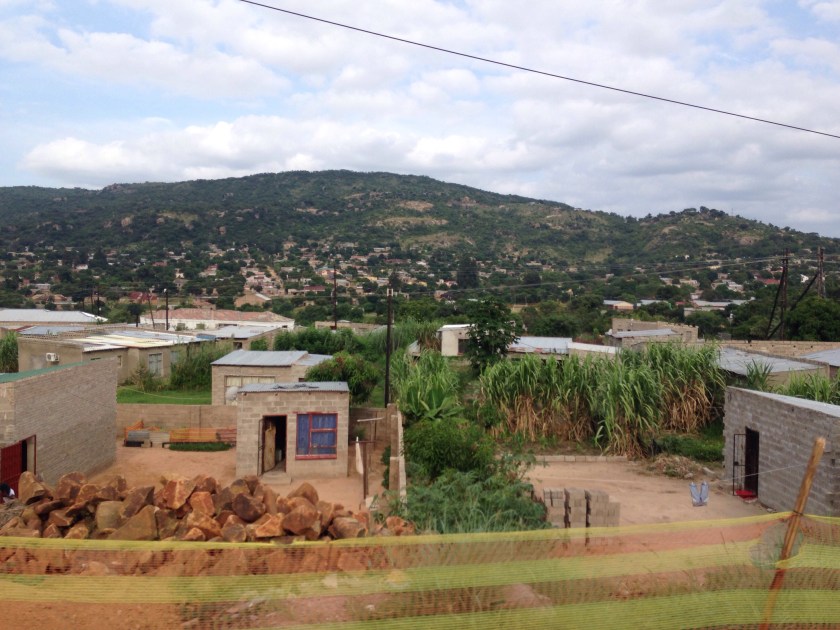
The first half of this week I am visiting four organizations in two townships that my generous host, Liz Macintosh, thinks would be good places for Athenian students to work. The townships are Masoyi and Zwelisha. These are sprawling residential zones covering valleys and hillsides in the middle of rural areas. They stretch for miles, house tens of thousands of people, and don’t appear on my local map.
Last Thursday morning, we headed to Masoyi to visit Mshadza Special Care Center and Uthando orphanage. We heard there were protests blocking the road, but our sources said it was past our turn. As we got within 100 meters of where we would exit the main road, ironically located right at the local police station, there was a fire and rocks in the road. We turned back.
Liz had a gap year student, Isabella, placed at Mshadza. This was Isabella’s last day and Liz wanted to say good-bye. We called the head of Mshadza, Lucy, and she said to meet them at her home, which is located before the blockage. We waited in the shade of an avocado tree in Lucy’s yard and she and Isabelle soon arrived. We asked Lucy what the protests were about and were told ‘water,’ but we didn’t have much time together. We could see smoke from a new fire on the road, just above where we were. We were in danger of being trapped. Liz gave Isabella a quick farewell hug and Lucy accompanied us as we quickly drove out of the township.
We hoped to visit the organizations in Masoyi the next day, but were told Friday morning that the protests were even worse than on Thursday. Over the weekend, I heard several conversations where white South Africans derided the protests and expressed great doubt about their effectiveness.
On Monday morning I was supposed to head to Zwelisha, another township, to help at the primary school there and live with a local family. But I said that if we were considering having Athenian students work in Masoyi, then I needed to visit the organizations there. So we headed back to Masoyi on Monday. This time we arrived without incident.
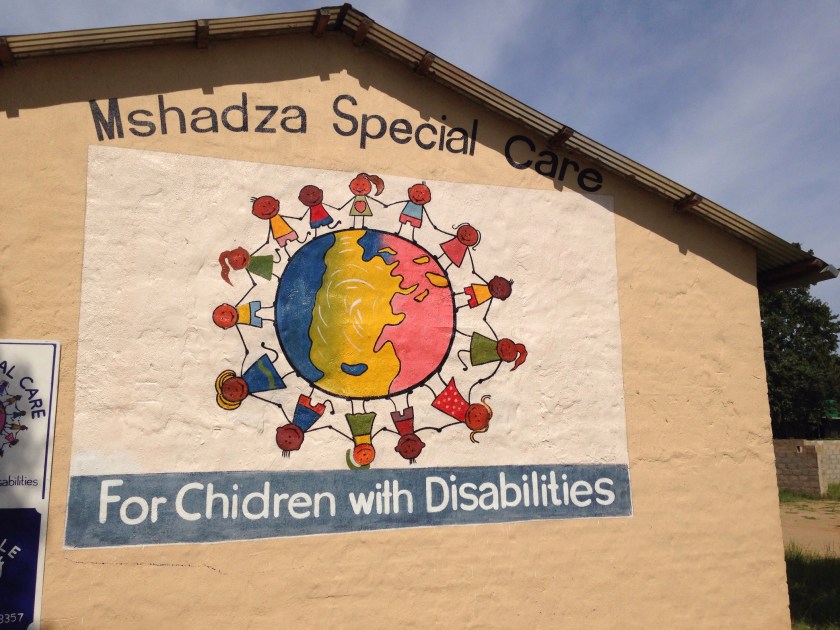
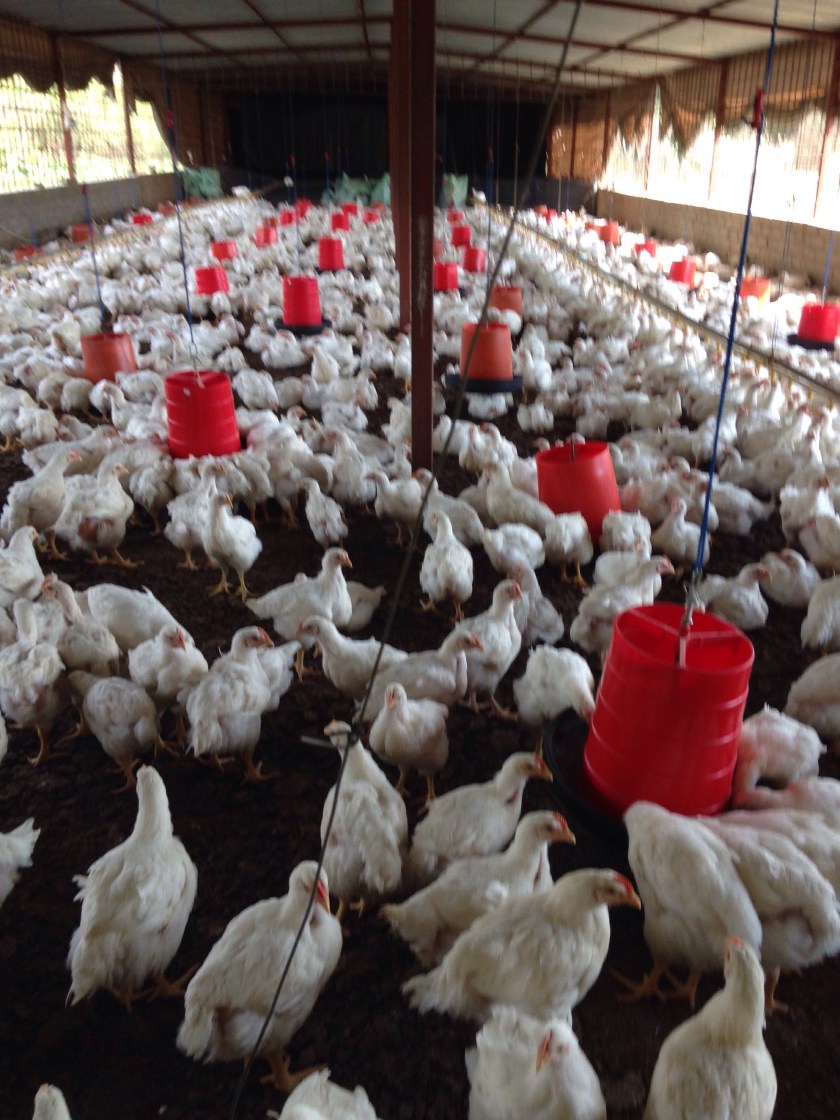
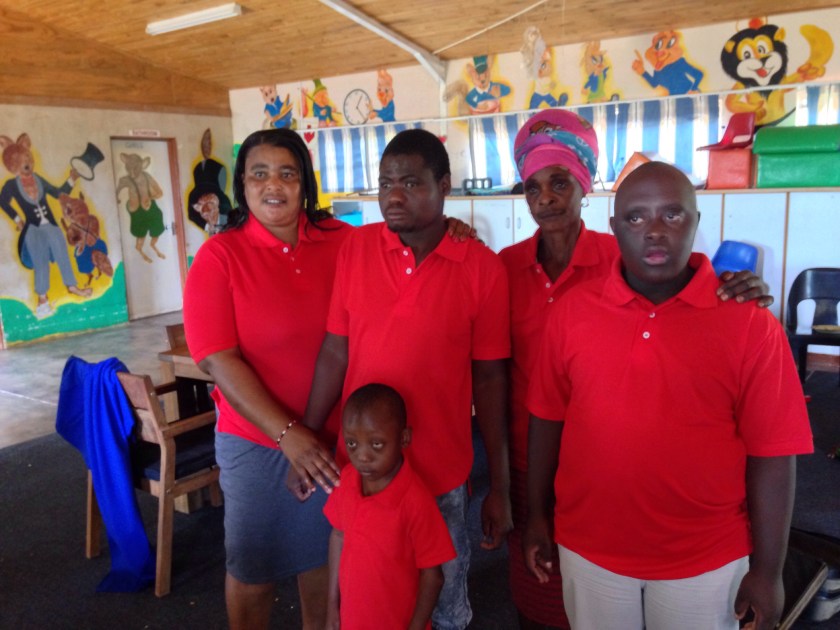
Mshadza Special Care is a program for young people with disabilities, both mental and physical. They have a large property with several big shade trees and a playground. They have so much land that Rotary built them a large chicken shed as an income-generating project. The centre wasn’t prepared to run a professional chicken farm, so now they rent out the building. They also grow corn and other vegetables to sell.
This was the third organization serving children with mental disabilities that I have visited in South Africa. Mshadza is a government-funded centre. It is akin to the one in the Huhudi township of Vryburg–a safe place for the young people but not a school. Round Square built a handsome classroom building at Mshadza a few years ago and there were children sitting in the classroom desks when we arrived; however, they had only recently gotten a teacher and she had already resigned. With 25 students of varying grades and mental disabilities, I don’t think the center aspires to more than teaching the students how to write their name.
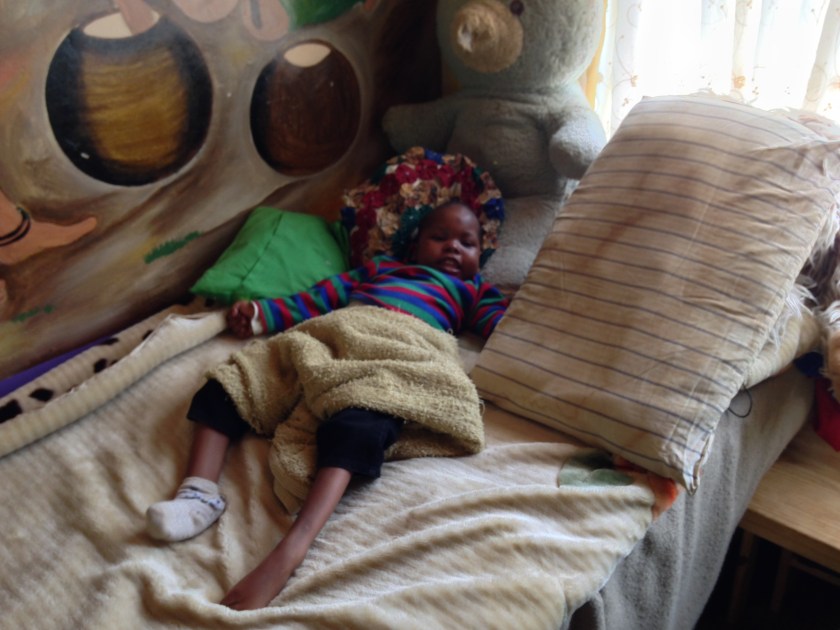
Besides serving breakfast, I saw almost no interactions between the children and adults. In the other main building, there was a group of young people playing together on the floor. In a corner were two younger children, lying on their backs on beds with nothing to do. The girl delivered huge smiles when Liz and I went over and cooed at her.
After we left, Liz told me about the two ‘children’ who are her favorites. One has a hunchback. She looks like a child, but is actually 30 years old. When the government officials visit, she looks like one of the children and so has been able to keep coming despite her age. She has nowhere else to go.
Immediately adjacent is Uthando Care Center, an orphanage with 24 children. Four children more are arriving within days. Liz said that most of the children there lost their parents to AIDS and are victims of human trafficking. There was another large orphanage nearby that was overcrowded and the local people wanted it shut down. In order to make sure that this orphanage closed, its neighbors burnt it to the ground.
We chatted with Tracy, the woman in charge of Uthando. She said that the government had cut off the water to everyone on this side of the Masoyi township a few weeks ago. She couldn’t explain why. As you can imagine, this caused much hardship, including for the orphanage. (Mshadza has a bore hole and so its own water source.) Tracy said that the government had agreed to turn the water back on in response to the protests, so apparently they had been effective.
In the late morning, we headed off to Zwelisha. This is part of another sprawling collection of townships on tribal land. The local family I am staying with seems to be one of the wealthiest around. Their home has two stories, marble floors, fancy shower fixtures, and an electric fence atop the surrounding wall. It is still being constructed so it also has no sinks, no kitchen counters, and only two chairs. Two brothers live there, one is an attorney and the other rescues bankrupt municipalities, so not your typical township family.
The brother who works with municipalities talked a lot about their problem collecting revenue, not about excessive spending. Water is included in the South Africa bill of rights. He said that every household gets 6,000 liters of water a month, but the government doesn’t have a way to measure how much people use. He said that governments can’t cut off water to force people to pay taxes. The municipalies that have had success getting people to pay taxes owed are those that also control the electricity, because this can be cut off in South Africa without running into human rights issues.
I am exploring having Athenian students work with Zwelisha Primary School and Zwel Kids, its after-school program. On arrival at Zwelisha Primary, Liz and I met with Tandy, the principal. Zwelisha Primary goes up to grade 7 and has over 1,200 students. Liz asked about class size. The principal didn’t want to talk about it, but eventually acknowledged that it ran from 35 students per class up to 75 for three grades.
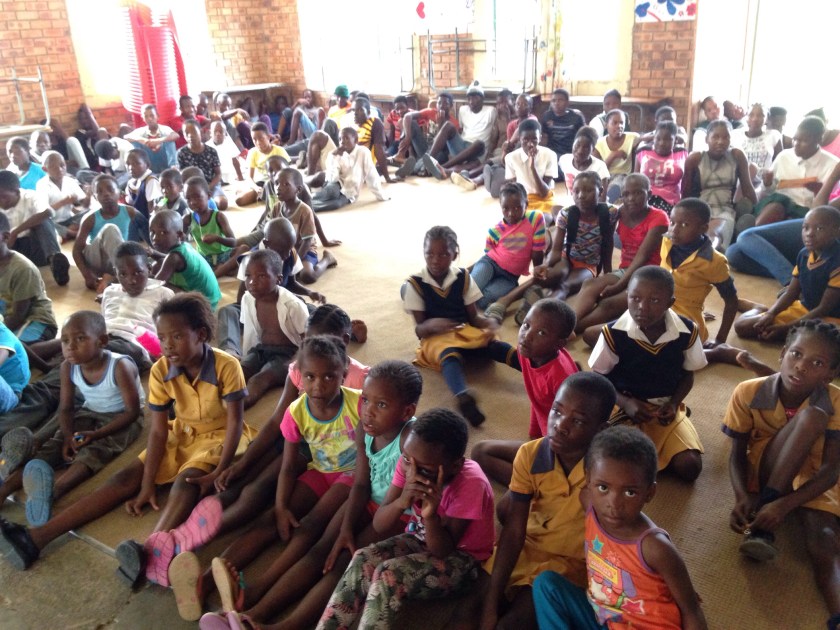
I spent the afternoon at Zwel Kids, the afterschool program. Zwel Kids serves ‘orphans and vulnerable children.’ Swati is the local language. Students speak it at home and it is the language of instruction through grade 3. In grade 4 the language of instruction switches to English. Tandy said grade 4 is the toughest grade and where she puts her best teachers. Connen, the director of Zwelkids, said that some of the students learn to read and write in English, but not to speak it. As you’d expect, the young people at the afterschool program were happily jabbering away in Swati. As I thought about Athenian students working there, I started making a list of games and activities that we could come prepared to lead, ones that didn’t require too much language.
It’s the end of the term and so the students are all writing exams. I write this sitting with grade 7A, who are taking their exam in Social Sciences History. The topic is ‘The Kingdom of Mali and the City of Timbuktu in the 14th Century.’ Half the test is multiple choice questions. The correct answer to question one is Timbuktu and to question two is Mali.
Class 7A only has 42 students, so it is one of the smaller classes on campus. There are some light fixtures in the ceiling, but no light bulbs. All the light comes from the windows. There is a chalk board, a bulletin board with nothing on it, and two posters for Plant Cells and Leaves. The only other thing on the walls is graffiti. Beyond the exams and anything the students might have in their backpacks, there were no educational materials in the room.
I was at school at 7:15 for the daily teachers’ meeting. The meeting began with a couple of songs that would have made a gospel choir proud. The lyrics to the first song were variations on the phrase ‘I will never give up.’
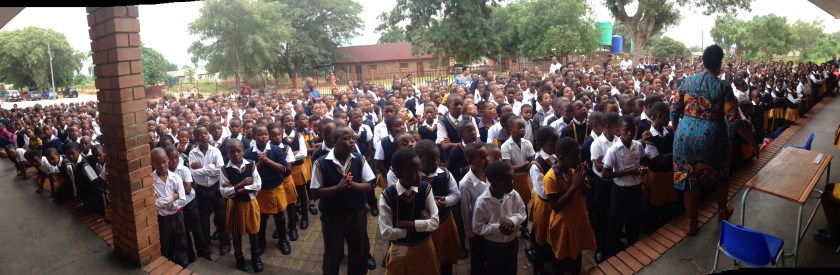
Tomorrow is a national holiday in South Africa—Human Rights Day. It is the anniversary of the Sharpeville Massacre in 1960. There was a special all-school assembly at the start of school. The students stood in long lines by grade. The meeting began with some chants and songs. I was introduced. The fact that a teacher had traveled all the way from the United States to visit their school was a source of pride. The girls’ soccer team had won the provincial soccer championship two years ago and received a bus for the school. The bus was on display. The boys soccer team has a match today in this year’s provincial soccer tournament and the school gave a loud cheer to encourage them.
A few students did a presentation about the fight to end apartheid and Mandela. One girl acted out someone shouting abuses in Afrikaans at black students. As the one white person amongst the 1200+ people there, I wondered to what degree I was associated with that abuse in their minds. The principal explained the significance of the Sharpeville Massacre and, to close the assembly, led them in The Lord’s Prayer.
I spent much of the day watching the boys’ soccer team. The match was at a field at an abandoned teachers’ college. We had beautiful views over the valley looking at the mountains, but the school grounds had a post-apocalyptic feel to them. The grass on part of the soccer field hadn’t been cut in a while, so the ball would slip from view and roll reluctantly when play got to that area. All three teams had bright green uniforms, so to distinguish the players you had to look at the shape of the number or the striping on the uniform.. Zwelisha won one game and tied the other, so they advance to the next round. The boys were singing and chanting in the bus for most of the ride home.
We didn’t get back to school until the late afternoon. Fortunately, I was in time to watch the after-school program’s gum shoe dance group practice! The final act of the after-school program was to give all the students a sandwich, apple and glass of juice as they left at 4:30. The students hadn’t eaten anything since the morning snack break at 10:00 am. The after-school center won’t be open for the national holiday tomorrow because they’d have to feed the students a mid-day meal and don’t have the money for it.
This is South Africa. Vibrant friendly people. Amazing cultural diversity. Great natural beauty. Along with extreme inequity, racism and inefficient government.
There was a road blockage protest in the area of Zwelisha yesterday. The issue is again water. Because I was living in the township, the protest didn’t affect me. I didn’t even hear about it until the next day when I wanted to leave. Apparently the locals all know how to get around the road blockages, so it is mostly white people who are affected.
I loved living in Zwelisha for a few days, walking the dirt roads and talking with people. I think I finally figured out why. When you are in a township, you are in black Africa. Suid Africa is out of sight. And these communities remind me of Tanzania, where I lived for a year.
On Monday, I visited Penryn College, a Round Square school in Mbombela (formerly known as Nelspruit). The Penryn student body looked to be over 60% black. I think that many of these students are from other African countries. Mozambique, which is very close, is apparently booming with lots of Chinese investments coming in. Mbombela/Nelspruit is the fastest growing city in South Africa.
At Penryn, I sat in on a drama class. The students were working in small groups developing brief plays. The play had to address a problem in modern South Africa (such as income inequality, the oppression of women or corruption) and had to do it using post-modern theatrical techniques. In one play, the students were the admissions committee at a university. Jacob Zuma’s child had applied and had very poor marks; however, the committee members had all been paid a bribe and so his child was admitted. A colored student was admitted to diversify their student body. A white student with outstanding marks and accomplishments applied. The admission committee in unison chanted REJECTED!
I am in the White River area for ten days scouting out a service-oriented Athenian School trip I hope to lead next year. Round Square organized service projects in this area for several years and my host is the local woman that Round Square worked with, Lis Macintosh. Liz is white and from Zimbabwe, having left soon after the country gained its independence with Robert Mugabe as its leader. A big topic in South Africa is land redistribution. The ANC is looking to amend the constitution to allow land redistribution without paying the current owner. Liz and a friend were talking about this last night, reassuring themselves that South Africa would not become another Zimbabwe.
Liz has a black colleague, Neeto, and he gave us a tour of some local townships on Wednesday. The local townships are far from Mbombela. You’ll be driving along in the middle of a fully rural area miles from the nearest town. You go over a hill, and boom. There is a sprawling township where hundreds of thousands of blacks live.
Neeto said that older blacks think that conditions were better under apartheid than under the democratically-elected ANC government. I asked him how this could be. He said that the levels of corruption were so high that there was less money to spend in the townships now. I said that it seemed that if that was true they should change the government. He said that wouldn’t make any difference because all politicians are the same. This is a black man who has been very successful. He was recently honored as the Entrepreneur of the Year in Mpumalanga province. Yet, he feels hopeless and powerless.
Neeto took us to an orphanage that he and Liz support named Angel’s Hope. The orphanage has 14 children and is run by Mary and her husband, Jacobus. Jacobus was sitting with his feet raised and told us his doctor said he should rest. I assumed he had some injury to his feet. As we drove away, Neeto reported that Jacobus had kidney failure. Neeto continued: ‘In South Africa, if you don’t have money, you die.’
The next day Liz and I visited several schools where Round Square students have built classrooms. It was a treat to see these facilities being used. Athenian students participated in all of these projects and it was inspiring to imagine them working here. For one school, the new classrooms transformed the school. The improved facilities allowed the school to attract more students and white teachers and the white teachers attracted still more students. The school had 300 students when Round Square build the classrooms a few years ago. Now the school has 900 students.
Class size for most government schools in South Africa runs from 45 to 90 students. A ranking of education systems by the Organization for Economic Co-operation and Development (OECD) placed South Africa 75 out of 76. In other words, South Africa ranks behind many poorer nations. For example, in Tanzania only 4% of students who have completed six years of schooling can’t read. In South Africa, the figure is 27%!
Being in South Africa, I often reflect on the history of racism towards people of African heritage here versus in the United States. Moreover, there are also lots of cultural connections between black Africans here and African Americans in the United States. But when comparing the United States and South Africa, the group in the USA whose position is probably most akin to that of black Africans is Native Americans.
Crazy Horse and a Zulu Chief, both pictures from around 1870
Native Americans and black Africans were the indigenous people of these two lands when Europeans arrived and began colonizing. The Portuguese, searching for a sea route to India and China, first circumnavigated the southern tip of Africa in 1488. Columbus’ Spanish-financed expedition arrived in the Americas just four years later. Despite the mistreatment of black Africans here, slaves in South Africa were from places like India and Indonesia. Something similar happened in North America, where it was difficult to enslave the native people and so slaves were brought in from elsewhere.
I sat in on a history class at Penryn College yesterday. They were in the middle of a long section on Native Americans. The focus on the day that I was there was on the Battle of Little Big Horn. The class went into great depth on the culture of the Plains Indians, the array of Custer’s forces, the reason for the battle. The teacher always referred to Custer and the US Calvary as ‘Europeans.’ I doubt that Athenian students study the Battle of Little Big Horn in such depth—or know anything about the Battle of Blood River.
The Voortrekker Monument in Pretoria is surrounded by a circle of 64 wagons, representing the 64 wagons at the Battle of Blood River in 1838.
I stand in South Africa and find myself imagining an alternative past, one where Native Americans had immunities to European diseases and so their population wasn’t decimated by the arrival of Europeans. I think about an alternative present where 80% to 90% of the United States’ population is descended from people who lived on the continent in 1492 and only 10% to 20% from people who arrived post-1492. I imagine a United States that, like South Africa, has many official languages: Apache, Blackfoot, Cherokee, Chippewa, Choctaw, Chumash, Delaware, English, Hopi, Iowan, Mohawk, Mohican, Narragansett, Navajo, Omaha, Osage, Pima, Salish, Seminole, Shawnee, Sioux, Wampanoag, Yupik, Zuni …
It’s Friday afternoon in Johannesburg on a gorgeous summer’s day. After a long swim, I sit poolside at my hotel. This is perhaps the most work-related week of my sabbatical. I’m staying at a nice but corporate hotel located immediately next to St. Stithians, a Round Square school. My days this week have been spent either visiting schools or visiting historical sites where I might bring Athenian students.
Monday morning, I took Uber to central Johannesburg to tour Constitution Hill. I had a ticket for the 10:00 am full tour, but they asked if I would come back at 1:00. I went to explore central Jo’burg and, another Uber ride later, I was at Mary Fitzgerald Square (a labor leader). The area around the square looked sketchy and, given all the safety warnings I’ve been given, I headed in the other direction. I took a left at the first street. Suddenly the mood changed. There was an outdoor café across the street from a theatre–and there was a large mall just next to that. It turns out the South African International Film Festival is at that theatre this week and so I bought a ticket for the film at 8:00 that night.
Constitution Hill is the site of an old jail, built before the city of Johannesburg was founded. A fort was added after the Jameson Raid in 1895, an attempt by the British to annex the area after gold was discovered. The jail was closed in the 1980s. After the end of apartheid in 1994, part of the prison was torn down and reconstructed to be the court buildings for the supreme court in South Africa—hence the name Constitution Hill.
Constitution Hill – Gate to solitary confinement cells for non-white men
For six dollars, I ended up one-on-one with a great tour guide, Brenda, for over two hours. There were separate jails for men and women and then within that for white and non-white prisoners. As you might imagine, the conditions for the non-white prisoners were significantly worse—more crowded, less food, more humiliating. Brenda described how non-white prisoners were forced to take off all their clothes and do a ‘dance’ under the guise of the guards being able to make sure they weren’t hiding anything. I was reminded of the tactics at Neuengamme, a Nazi work camp outside Hamburg that I visited with students 18 months ago.
Some of the inmates at the Johannesburg jail were ordinary criminals. Some were political prisoners, the most famous being Mohandas Gandhi and Nelson Mandela. The political prisoners included whites who were opposed to apartheid and they were treated very harshly as well. Under apartheid, blacks had to carry a pass at all time or risk arrest. Some of the inmates were people who went out to do a chore, didn’t have their pass, and ended up in prison for months.
Brenda lives in Soweto. She talked about how transformative the World Cup was for South Africa and how it played a key role in launching her career as a guide. We explored the possibility of her organizing a tour of Soweto for Athenian students in the future.
Before the film, I hung out at the café across the plaza from the theatre and watched the directors and cast have their picture taken. There was not a large crowd for my film, with only 30-40 people in the audience. As it turns out, the film was based on a true story of a man who worked with prisoners in the 1980s to use drama to express truths about their lives. While the actual prison was in Durban, the movie was filmed at the prison on Constitution Hill. I couldn’t imagine a more fitting conclusion to my day.
On Tuesday, I visited Liliesleaf Farm in the suburb of Rivonia. The farm was a secret meeting place for the African National Congress (ANC), which was a banned organization in South Africa for many decades. The ANC was worried that too many people knew about the farm’s existence and held one final meeting there. The police conducted a raid that very day and captured all the senior leadership of the ANC, which was a major setback for the liberation struggle. Nelson Mandela had been recently captured, the CIA providing all the information that led the South African Security Forces to him. The Rivonia Trial in 1963 included those arrested at the farm and Mandela. They were all convicted to life sentences—this is the sentence that sent Mandela to Robben Island for 30+ years—but the defendants were able to use the trial to publicize their cause to an international audience. It was interesting being at a museum site where the perspective provided was so opposed to that of the country’s government when the event occurred.
On Wednesday, I was off to the African Leadership Academy. This is a unique school. It has 250 students from 40 African nations. Only 5% of the students are from South Africa, so it truly is a pan-African institution. They run a two-year program, which is the last two years of secondary school for some and comes after graduation from secondary school for others. In addition to traditional subjects, the school has three focus areas: entrepreneurial leadership, African history, and writing & rhetoric.
Dining hall at African Leadership Academy
I had a fascinating day there: talking with a girl from Botswana about ethical leadership, hearing a girl from Zimbabwe say that she cringes every time she hears Robert Mugabe’s name, discussing with a boy from Morocco his plan to increase financial literacy among farmers in his country, listening to a history class debate whether Queen Amina of Nigeria should have statues honoring her. Just that morning I read about Sherman Alexie and the charges of sexual abuse against him. I mentioned him as another example of the challenges of deciding how to respond to people who do both good things and reprehensible things.
At the end of the day, I met with a group of teachers to discuss service learning and community service. While it is part of the school’s mission and goals, in practice they don’t do much of it. It’s interesting because there are 24 student-run enterprises as part of the entrepreneurial leadership program. It seems like this model would lead itself to having some enterprises that are focused on supporting groups or issues in the broader community, but this is not the case.
Thursday took me to Crawford College Lonehill. A girl from the school is coming to Athenian on exchange in March and we’re sending someone there in July & August. We’ve never worked with this school before, so it was good to establish a connection. I had dinner with the girl and her father. She’s confident, outgoing and hard-working. And she’s already into bubble tea, can’t wait to experience In ‘n’ Out Burger, and knows which chain stores aren’t in South Africa that she wants to visit. Her father lived in the United States for five years when he was a professional golfer. He said those were the best years of his life.
Today I was at St. Stithian’s Boys College. The school is 60 years old and there are now five schools on its huge campus. A hike around the perimeter of the property would cover six kilometers. This school is very different than Athenian. All boys. Lots of different ties and blazers and caps to designate students with different honors. Chapel three times a week, two of which are really school assemblies. The student leaders from the girls’ school came to the assembly I attended, which meant that the boys were much more agitated than usual. It was the end of a sports season and sports are big at Saints (as the school is known). Most of the assembly consisted of reading out the achievements of the athletes. Every sport was covered and, in many cases, there were medals and trophies distributed.
Their English classes include film studies. I sat in on a class that was analyzing the film The Secret Life of Walter Mitty. We got through ten minutes of the film as the teacher stopped the film every 45-60 seconds to discuss what was going on and to unpack the different cinematic effects being used (e.g. music, blocking).
There were no classes during the last period of the day so that the boys, all 800+ of them, could practice the ‘war cries’ they chant at sporting events. This was quite a ritual to witness. One chant was a song that had revised lyrics to John Denver’s Take Me Home, Country Roads.
I spent a period chatting with Jonathan, who came on exchange to Athenian two years ago. He is now the Prefect for Round Square at the school. We talked about Saints and he was looking for ideas to improve Round Square at his school. I asked him how coming on exchange had effected him. He said it was one of the most profound experiences of his life. He said that not a day goes by when he doesn’t ask his parents about coming to visit Athenian again. He wanted to come for senior prom, but that didn’t happen. Now he’s shooting for coming back for graduation in June. He mentioned that homophobia was a problem at his school. Because he came on exchange to Athenian he has more ability to talk about homophobia than most of his peers and has taken some initiative on the issue at his school. Talking with him reminds me why I do this work.
10. The best pizza in Johannesburg is not found at Pizza Hut.
9. You can’t use Uber to get around Lusaka.
8. People in Johannesburg do not greet the arrival of a new Pick n Pay as an indicator of economic transformation.
7. Johannesburg is the largest city of a country that year after year has one of the highest rates of economic inequality in the world.
6. You can walk safely around Lusaka.
5. In Johannesburg, there is the history of apartheid to explain how their townships got created.
4. At immigration at the Johannesburg airport, the number of people in the diplomat line is not 1/3 the number in the visitor line.
3. In Johannesburg you can visit monuments to white pioneers as well as the homes—and prisons–where Nelson Mandela and Mohandas Gandhi stayed.
Voortrekker Monument in Pretoria
2. It is not common for white people in Lusaka to have an existential sadness about the country.
In Lusaka, there are few people with extra body fat. In Johannesburg, there are so many large people that men’s clothing sizes are one and even two sizes larger than in the USA. I bought a medium-sized shirt here. In the USA I buy extra-large!
The family I am staying with in Zambia—parents Ken and Joy and children Jenny and Lucy—are all at the American International School of Lusaka. They’re out the door at 7:00 each weekday morning. I’m on sabbatical and Appleseed runs on a later schedule, so I awake after they leave and get ready at a relaxed pace. Audrey, the house cleaner and cook, arrives at 8:00 and starts on the dishes from dinner the night before.
The walk to Appleseed each morning is one of the highlights of my day. The first half is on dirt roads past corn fields and green woods. Then I turn a corner and am looking down a paved road into the Bauleni compound. The streets and pathways of Bauleni seem to always be full of people. The men look like they could have stepped off the streets of Oakland, while most of the women are wearing a chitenge, a traditional wrap around skirt.
I pass small homes made of cinder blocks, often with long lines of clean clothes out to dry. The 3 and 4-year-olds playing in the dirt often call out ‘mzungu’ as I pass. Mzungu is the one Swahili word I’ve heard here and means European/white person. Interestingly, the use of the word began hundreds of years ago when European explorers arrived in East Africa. Mzungu is based on the Swahili word for a person who wanders around aimlessly. Perhaps the word is more fitting for me than I acknowledge.
I pass tiny shops with piles of four tomatoes, small plastic bags of charcoal, and small bags of potato chips that are more packaging than food. Some of the shops are painted the distinctive color of one of the mobile phone companies—yellow for MTN, green for Zamtel, red for Airtel. I pass two elementary schools—one of them has over 4,000 students–and a dirt/mud football pitch. I make a right turn at the second big green water tank, where people with plastic buckets gather for cholera-free water.
Appleseed is up the road from a little shopping district in Bauleni. There is tiny hardware store, a few ‘business centers’ with a computer and printer, and a ‘barbar’ shop. For the furniture makers, both the production and the show room are outside. The wood is all planed by hand, which is physically demanding, and the product line appears to be mostly bed frames and wooden doors. As we get closer to Appleseed, I run into young people who know me and call out my name to say hi.
If I arrive at Appleseed early enough, the daily morning clean-up is still going on. There is so much dust and dirt that Appleseed needs to be cleaned every morning—and the floor and yard swept a couple of times during the day. The computers all have cloth covers over the keyboard, screens and CPU towers overnight to keep out dust and dirt.
There are always young people at Appleseed during the school day and on arrival I look for some to interact with. The local schools run in two shifts with half the students attending from 8-12 and half from 12-4. Most people here are tri-lingual–Bembe, Nyanja and English–but English is learned last. This mean I usually work with the 10-13 year olds. We read books, play games, do homework, sing songs. They are vivacious, bright and beautiful. They speak three languages, but their academic training is pitiful. Several of my favorite 13-year old read at the level of a second or third grader. The little book where I keep notes is full of words they’ve asked me how to spell, such as friend, brother, mother, don’t, love and lovely, thank you, so much and sponsor.
Zambia’s educational system has must-pass tests at the end of grades 7, 9 and 12. Students get shuffled along with their age cohort up until these tests. I can’t imagine how most of the young people I’ve gotten to know will pass the test at the end of grade 7. I wonder what my young friends’ lives will look like in a year-and-a half when they’re 14 or 15 and potentially out of school?
One of their favorite activities is to make drawings and cards. There are lots of colored pencils and because I’m here they have better access to the precious white paper. I have received dozens of beautiful pictures and cards full of hearts and ‘I love you.’
They have initiated several sessions of video making and picture taking. They created two dramas I filmed. Each had a similar theme: a poor mother with lots of children (roles all played by girls) had her money stolen away by men (played by boys). They also initiated several photo shoots where I took dozens of pictures of the beautiful young people here.
Ken, Joy, Jenny and Lucy drive to Appleseed after school each day around 4:00 to pick me up. Jenny and Lucy have many friends here and so they may play, while Ken and Joy talk with people and solve problems. Then it’s over the hill and back to their house behind the wall.
After school, Jenny and Lucy often play with their friends on the dirt road in front of their house. One day, three of the girls I have gotten to know at Appleseed walked the 15 minutes to Ken and Joy’s house. I didn’t realize they were out front at first, but eventually I figured it out and went to talk with them. Dusk was falling, however, and the security guard and I shuffled them off because we didn’t want them walking back to the compound in the dark.
We eat dinner and Ken, Joy, Jenny and Lucy head to bed early. I stay up late, typing away and managing my digital world. Then we wake up the next day and do it all again.
It has been an honor and a treat to be here for two weeks, to be part of the Bauleni compound, to work with the adults and young people at Appleseed, to live with Ken, Joy, Jenny and Lucy. Tomorrow I catch a plane back to Johannesburg. A way of life is ending.
But it’s not just changing for me. Ken and Joy have lived in Zambia for seven years and Jenny and Lucy since birth. Joy’s last day at the American International School of Lusaka is in two days. If all goes according to plan, Jenny and Lucy will get their US citizenship one year from now. Soon thereafter, the four of them will leave Zambia, move to California, and start adjusting to a new reality: the American way of life.

 As the clock turns past three, traffic outside the café picks up, both in the number of cars and the number of pedestrians. The pedestrians are almost all black people walking downhill, presumably heading home after a day working at the homes of well-to-do families living on the slopes of Table Mountain.
 My last night in the Cederberg Wilderness. The stars are brilliant on a black moonless sky. The Milky Way is directly overhead, a faint wash of white. The stillness outside seems complete. I can’t detect any sound. No birds or insects or animals. No wind or rustling tree branches. No moving water. No human voices or machines. The only sound I can find is a buzz in my own head, like the hum of a machine that is rarely noticed.
 I went for a walk today from the lodge—another flat tire yesterday meant no driving today as I couldn’t risk the latest undersized spare on the dirt roads of Cederberg–and encountered a similar silence mid-day. The lack of noise is both calming and slightly eerie. This is a semi-arid region of brush and tiny flowers. Rooibos, of Rooibos tea fame, grows here. The destination for my hike was a rock formation that resembled an elephant. Rock elephants do not make trumpeting calls.
 Tonight, a couple from Cape Town and I were guided up Leopard’s Rock, which sits prominently just below my cabin here at Gecko Creek Wilderness Lodge. We saw some San paintings under a rock overhanging. The paintings were made 7,000 to 20,000 years ago with the blood of animals. We saw the blackened wall where the San lit their fire. I thought about their lives here, on this spot on the planet. They were a nomadic people. I am in a nomadic phase. Will I ever return to this rock?
 After seeing the paintings, the four of us climbed to the top of the rock outcropping, a climb that was more adventurous than a lodge in the USA would have allowed. At the top, we asked Ferai, our guide, questions about the San people and his own life. Ferai brought a drum and we drummed the sun down over the mountains.
 Gecko Creek has a braai area that seems designed like a temple. Most of the South African couples and families headed there to cook their dinner. Braai is not the South Africa word for Bar-B-Q. For South Africans—and maybe this is white Africaan’s South Africans—the braai is an important aspect of their culture. Each home I’ve visited has a place to braai outside. Not a portable grill, but a permanent structure. They prefer to braai with wood, though charcoal is acceptable. An Africaans man here scoffed when I said that most of the grilling I do in California is on a gas grill.
 In addition to the cooking fires, tonight a social fire was lit in the middle of the braai area. Two married South African couples told touching stories about how they met. One of them was a love-at-first-sight tale where they half-jokingly said they should get married in their first conversation—and decided for real within days! The man is from Saint Helena, an island in the middle of the Atlantic that is a five-day boat ride from Cape Town. Their lives have changed because there is now a once-a-week plane from Jo’burg. The other involves an Africaans woman and an English-speaking man. The friends of the Africaans woman were shocked.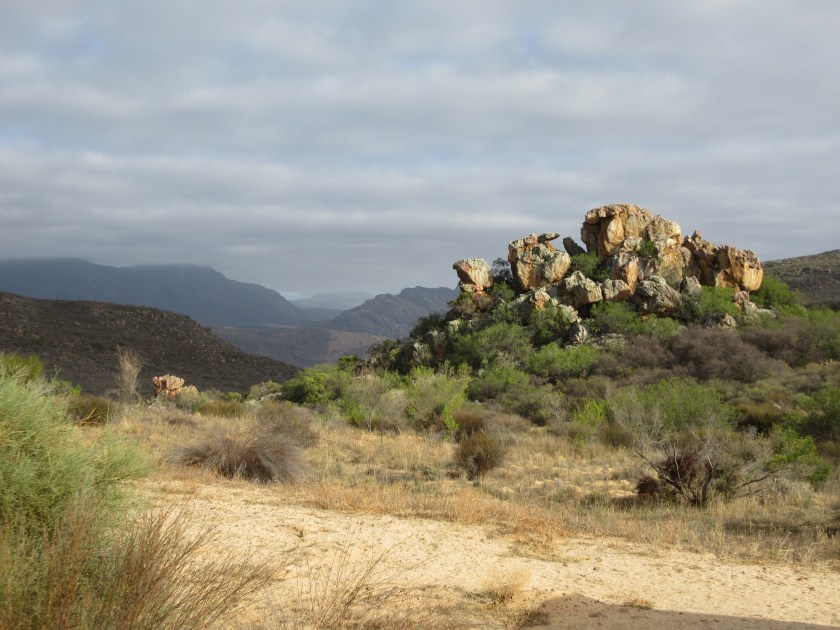
 bakkie. Noun. 1. (South African) a small truck with an open body and low sides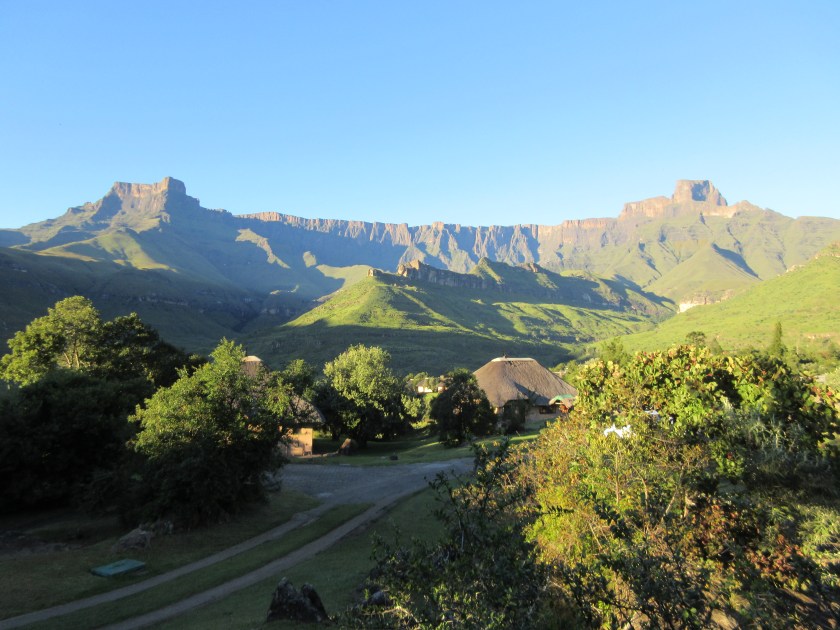
 But we didn’t just sit around. We did a short hike to Tiger’s Falls that afternoon and then a day-long hike towards the Amphitheatre the next day. The longer hike ended up following the Tugela River. As it gets closer to the Amphitheatre, the river enters a narrow gorge, which eventually becomes a tunnel. Hiking through waist-deep water in a tunnel was more adventure than we had in mind and so we turned back. When a group of four people in their 20s also decided it was too much, we felt relieved. We weren’t complete wimps. It did feel strange to be hiking through a national park in Africa without a guide. In our two days at Royal Natal National Park, every one of the guests we saw was white and every staff person, ranger and house cleaner was black.
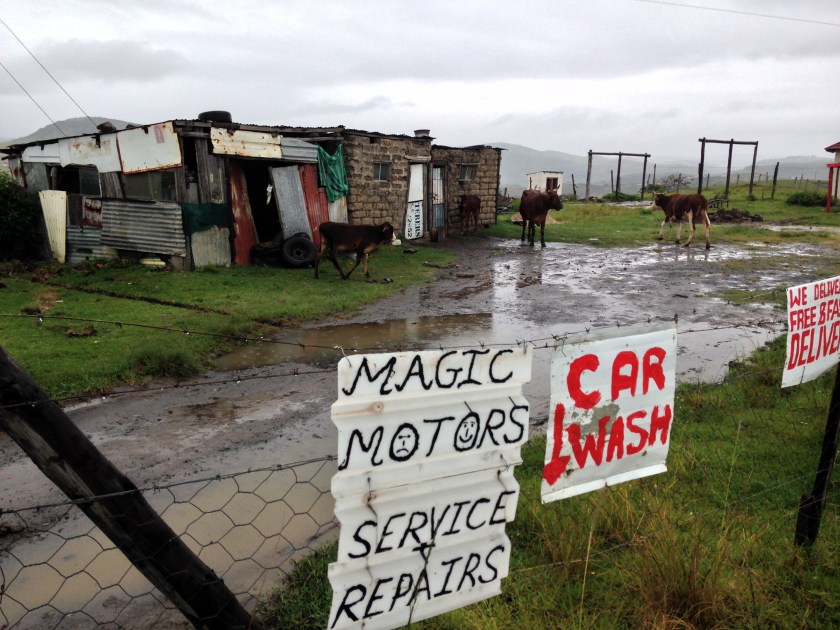 The folks at the Coffee Shack said that there was a guy in town who repaired tires. His shop was called Magic Motors. We drove there after breakfast in hopes he might be open and able to salvage our flat. His shop was a tin shack with cows and huge puddles of water in the yard. Parking the car I walked over in the rain. No one home. Looking at the place, maybe that was for the best. The flat tire would be a nagging distraction in the days ahead. Rather than just being focused on the beauty of the coast, I sometimes found myself worrying about how we would fix the tire.
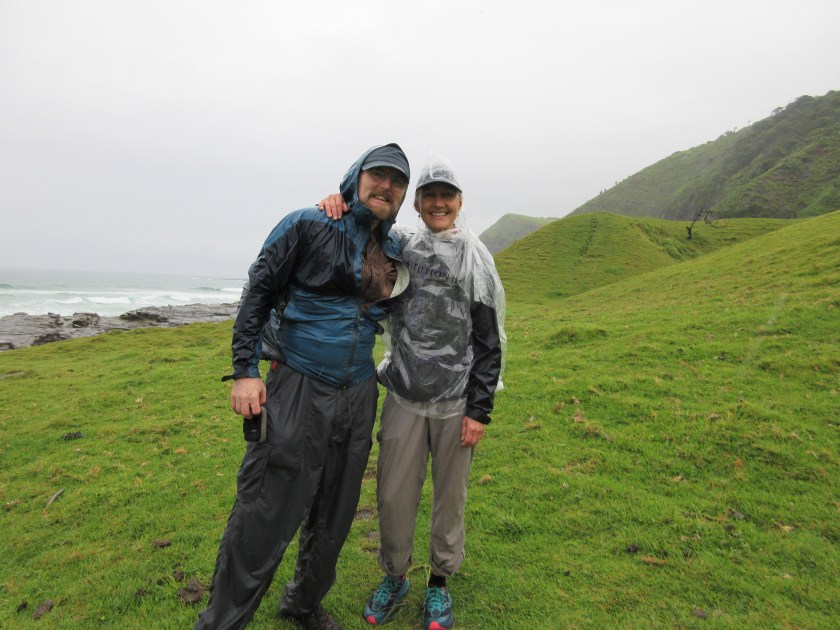 Back at the Coffee Shack, we met Isaac. He is 28 and his mother works at the Coffee Shack. He was wearing flip flips. His mother carved up three trash can liners for him to wear. We put on our fancy shoes and rain gear and headed off. It was the end of the rainy season and the hills were green. 2/3 of the way to Lubanzi was a natural feature called the Hole in the Wall. People went there as a regular day hike from Coffee Bay, but this day’s hike was certainly more adventure than we had planned.
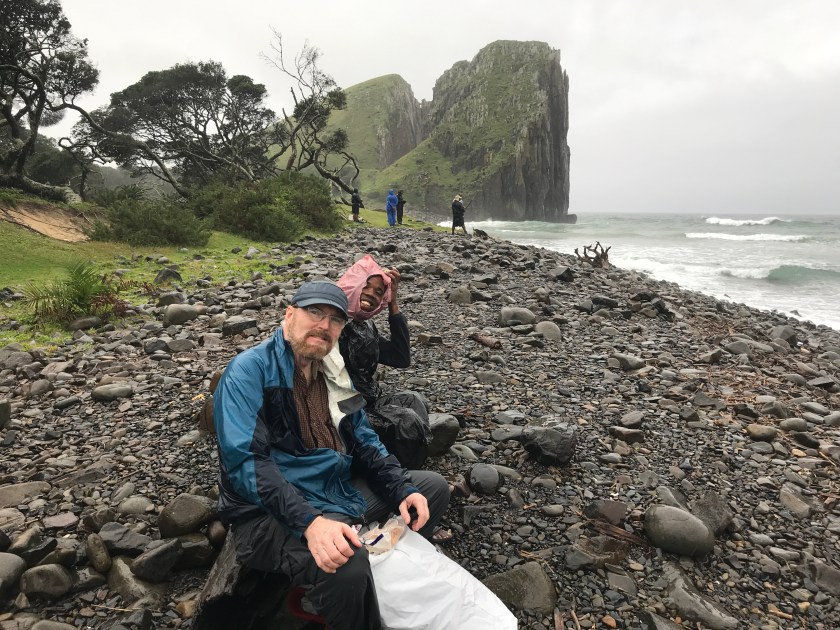 We climbed over one tall hill and came down to the Hole in the Wall. We sat in the rain eating cashews, drinking water, and looking at the hole.
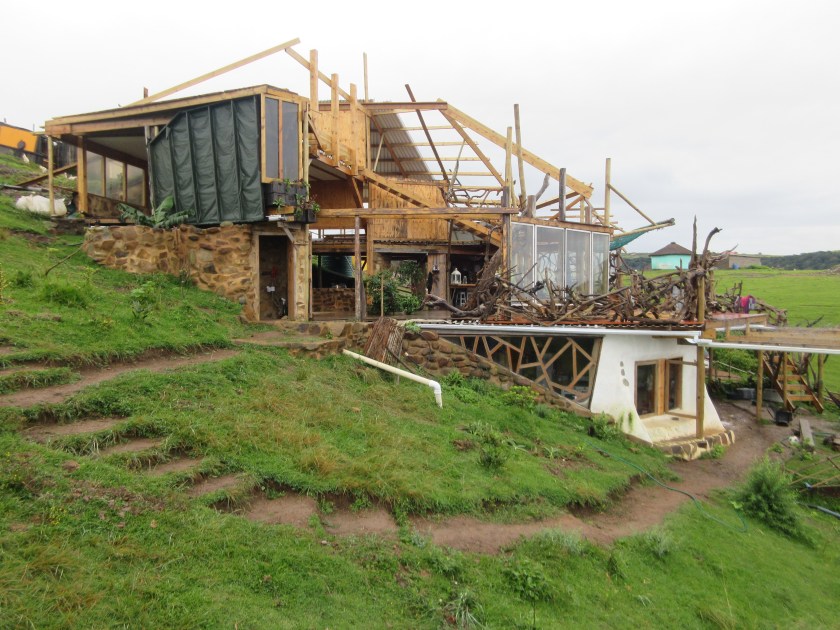 We arrived back at the coast as dusk we falling. We found a half-built lodge and, for us, a lovely tent overlooking the ocean. I know the locals ride the bakkies all the time, but I was so grateful that we got a ride here with Rahel and were able to skip two more rides on local transit and a walk in the dark.
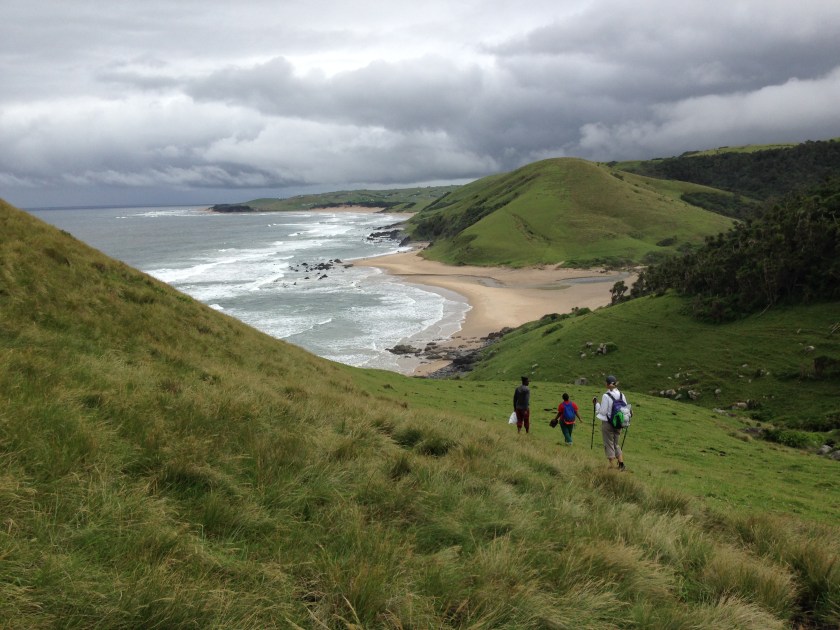 The next day there was no rain. The hike from Lubanzi to Bulungula only involved a couple of short exposed spots above the ocean. It was a beautiful walk.
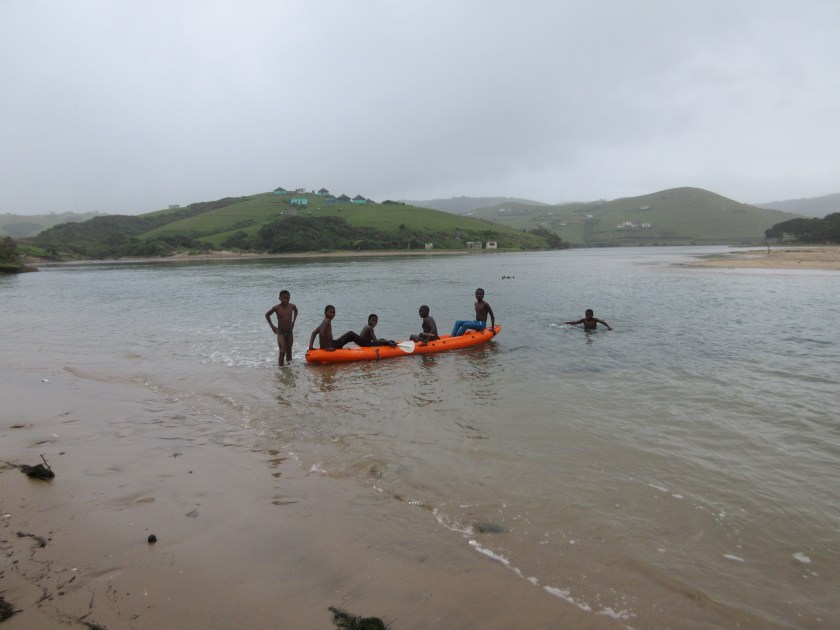 We got the best cabin at Bulungula, the one closest to the lagoon. Coffee Bay has a whole litter of backpacker hostels and lodges. In Bulungula there is just the one lodge—at the end of a 40 kilometer dirt road. This is a community-run lodge where you can do all sorts of great cultural experiences. A group was heading off for a women’s empowerment walk the next morning when we left. Because this is a community run lodge in a rural area, there was no need for security. backing, There were no fences to keep out people—or goats and pigs. And not only were there no bars on the windows, but they had lost the key to our cabin and so we couldn’t even lock the door.
 We were supposed to spend two nights at Bulungula, but even with four good tires we would have had to leave after one. Traveling here takes longer than I had figured on and we had to get back to the Coffee Shack to pick up our car. On the morning of Easter Sunday someone from Bulungula Lodge drove us the 40 kilometers on a dirt road to the main road to Coffee Bay. He was visibly relieved and proud when we made it to the main road. He helped us get a ride in a nice van and we rolled down to Coffee Bay.
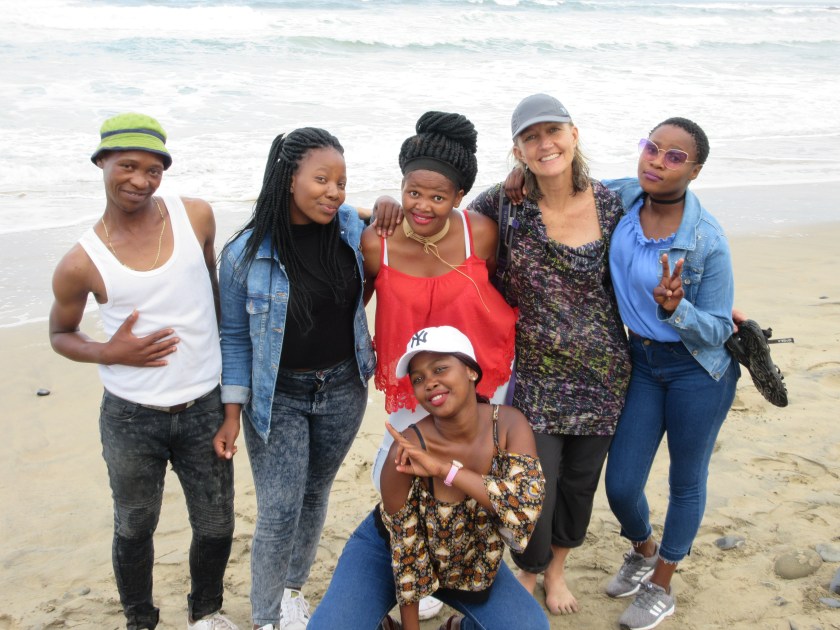 We ended the day by hiking up to an overlook where we could look down the coast to the start of our hike three days ago. We could just make out the trail cut into the side of the steep hill. Tomorrow was a 100 kilometer drive on a pothole filled road to Mtatha with no spare. We hoped for a little less adventure than we’d had in the previous days–and no rides in the back of a bakkie.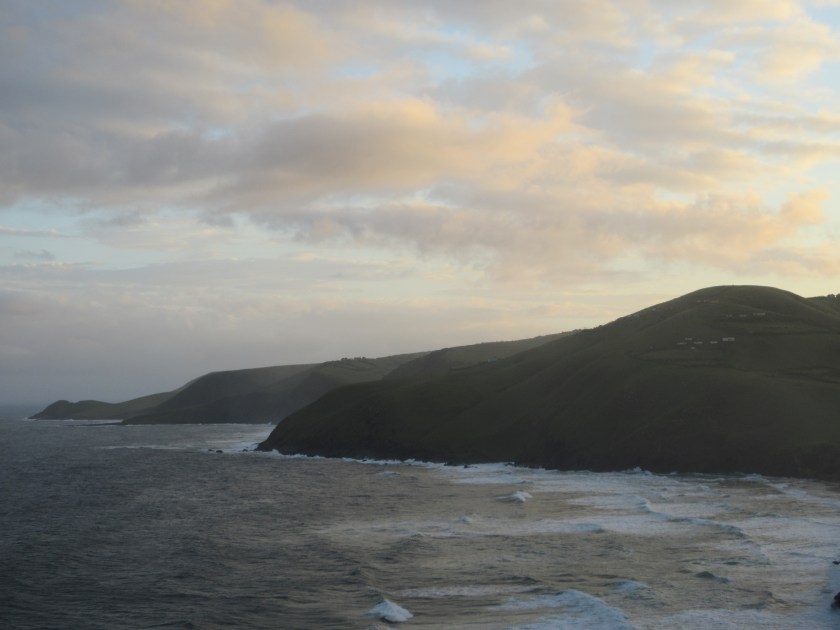
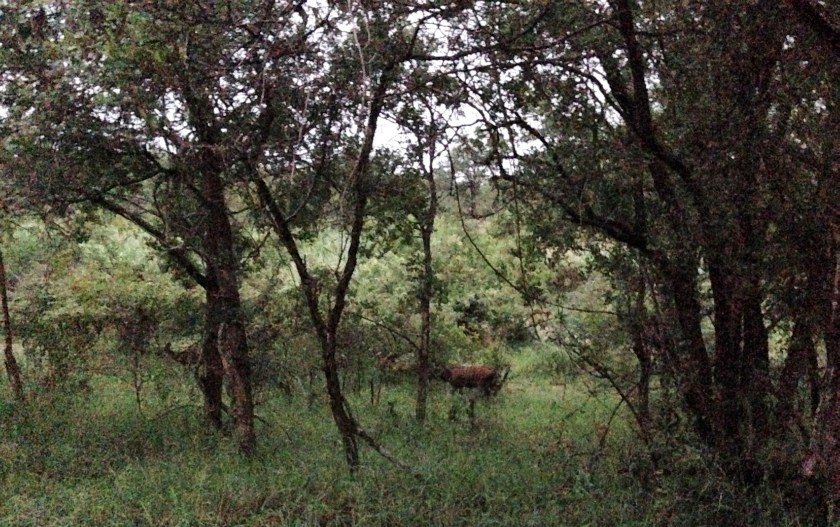 In the African bush, where the clay grew tall. At Eco Training’s Karongwe camp. Scouting for a possible Athenian school trip. Listening to the sounds of unfamiliar bugs and birds as a deep darkness falls. Two black African women set up the outdoor tables for dinner. The nine students here for a 55-day ranger training program and their instructor have not yet returned from an end-of-day game drive. They are all white.
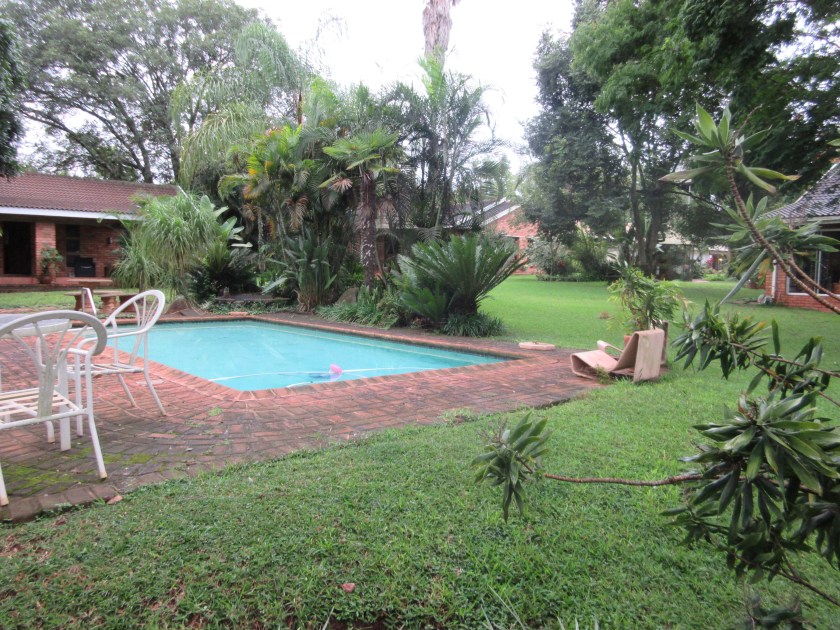 Wandering about the lawn are dogs—it seems that every white person in South Africa has at least one–and chickens and even a peacock. There’s also the black help. This morning I waved hello to a woman wearing a light blue maids uniform and white apron. I hadn’t noticed the male gardener, wearing a dark blue uniform and rubber boots, until a woman at another unit loudly called him over. Apparently, she wanted to know whether protests had closed a certain road.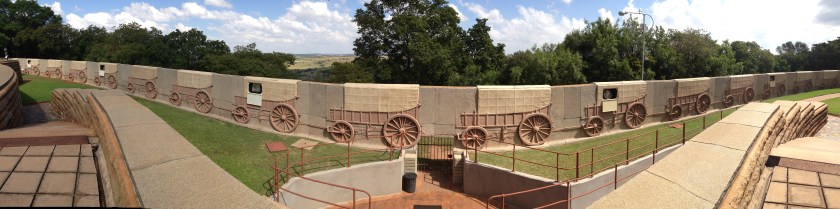
 Last Thursday morning, we headed to Masoyi to visit Mshadza Special Care Center and Uthando orphanage. We heard there were protests blocking the road, but our sources said it was past our turn. As we got within 100 meters of where we would exit the main road, ironically located right at the local police station, there was a fire and rocks in the road. We turned back.
 Mshadza Special Care is a program for young people with disabilities, both mental and physical. They have a large property with several big shade trees and a playground. They have so much land that Rotary built them a large chicken shed as an income-generating project. The centre wasn’t prepared to run a professional chicken farm, so now they rent out the building. They also grow corn and other vegetables to sell.
 This was the third organization serving children with mental disabilities that I have visited in South Africa. Mshadza is a government-funded centre. It is akin to the one in the Huhudi township of Vryburg–a safe place for the young people but not a school. Round Square built a handsome classroom building at Mshadza a few years ago and there were children sitting in the classroom desks when we arrived; however, they had only recently gotten a teacher and she had already resigned. With 25 students of varying grades and mental disabilities, I don’t think the center aspires to more than teaching the students how to write their name.
 Besides serving breakfast, I saw almost no interactions between the children and adults. In the other main building, there was a group of young people playing together on the floor. In a corner were two younger children, lying on their backs on beds with nothing to do. The girl delivered huge smiles when Liz and I went over and cooed at her.
 After we left, Liz told me about the two ‘children’ who are her favorites. One has a hunchback. She looks like a child, but is actually 30 years old. When the government officials visit, she looks like one of the children and so has been able to keep coming despite her age. She has nowhere else to go.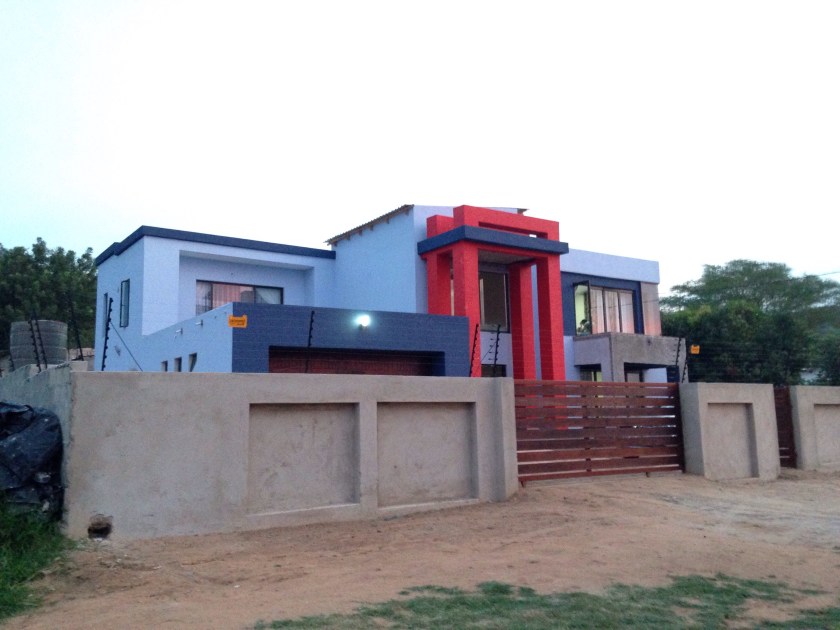
 I am exploring having Athenian students work with Zwelisha Primary School and Zwel Kids, its after-school program. On arrival at Zwelisha Primary, Liz and I met with Tandy, the principal. Zwelisha Primary goes up to grade 7 and has over 1,200 students. Liz asked about class size. The principal didn’t want to talk about it, but eventually acknowledged that it ran from 35 students per class up to 75 for three grades.
 I spent the afternoon at Zwel Kids, the afterschool program. Zwel Kids serves ‘orphans and vulnerable children.’ Swati is the local language. Students speak it at home and it is the language of instruction through grade 3. In grade 4 the language of instruction switches to English. Tandy said grade 4 is the toughest grade and where she puts her best teachers. Connen, the director of Zwelkids, said that some of the students learn to read and write in English, but not to speak it. As you’d expect, the young people at the afterschool program were happily jabbering away in Swati. As I thought about Athenian students working there, I started making a list of games and activities that we could come prepared to lead, ones that didn’t require too much language.
 It’s the end of the term and so the students are all writing exams. I write this sitting with grade 7A, who are taking their exam in Social Sciences History. The topic is ‘The Kingdom of Mali and the City of Timbuktu in the 14th Century.’ Half the test is multiple choice questions. The correct answer to question one is Timbuktu and to question two is Mali.
 Tomorrow is a national holiday in South Africa—Human Rights Day. It is the anniversary of the Sharpeville Massacre in 1960. There was a special all-school assembly at the start of school. The students stood in long lines by grade. The meeting began with some chants and songs. I was introduced. The fact that a teacher had traveled all the way from the United States to visit their school was a source of pride. The girls’ soccer team had won the provincial soccer championship two years ago and received a bus for the school. The bus was on display. The boys soccer team has a match today in this year’s provincial soccer tournament and the school gave a loud cheer to encourage them.
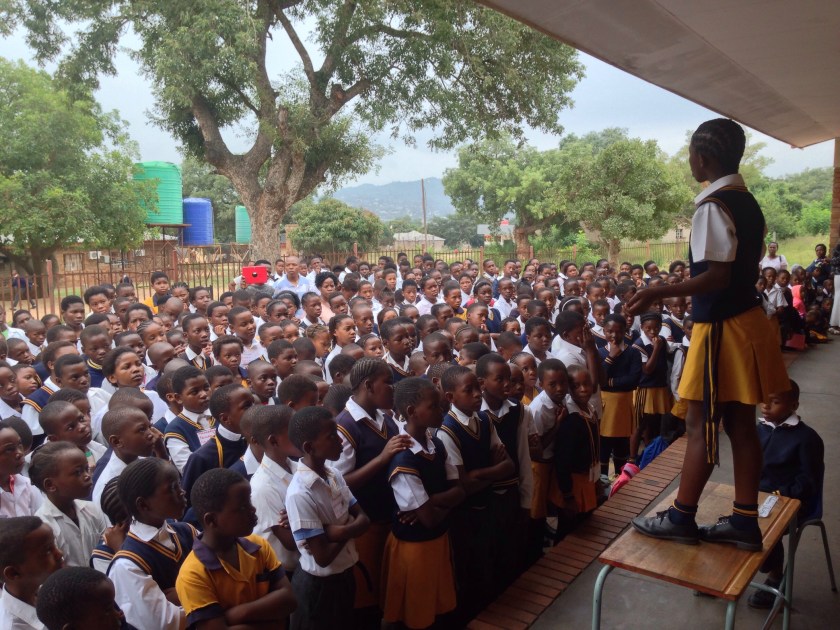 A few students did a presentation about the fight to end apartheid and Mandela. One girl acted out someone shouting abuses in Afrikaans at black students. As the one white person amongst the 1200+ people there, I wondered to what degree I was associated with that abuse in their minds. The principal explained the significance of the Sharpeville Massacre and, to close the assembly, led them in The Lord’s Prayer.
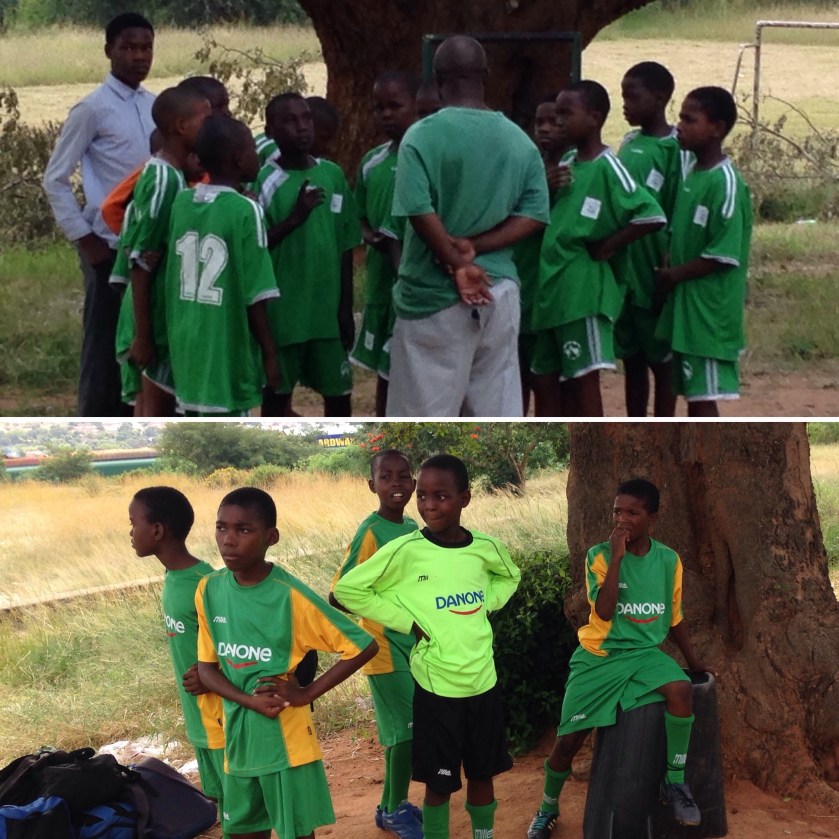 I spent much of the day watching the boys’ soccer team. The match was at a field at an abandoned teachers’ college. We had beautiful views over the valley looking at the mountains, but the school grounds had a post-apocalyptic feel to them. The grass on part of the soccer field hadn’t been cut in a while, so the ball would slip from view and roll reluctantly when play got to that area. All three teams had bright green uniforms, so to distinguish the players you had to look at the shape of the number or the striping on the uniform.. Zwelisha won one game and tied the other, so they advance to the next round. The boys were singing and chanting in the bus for most of the ride home.
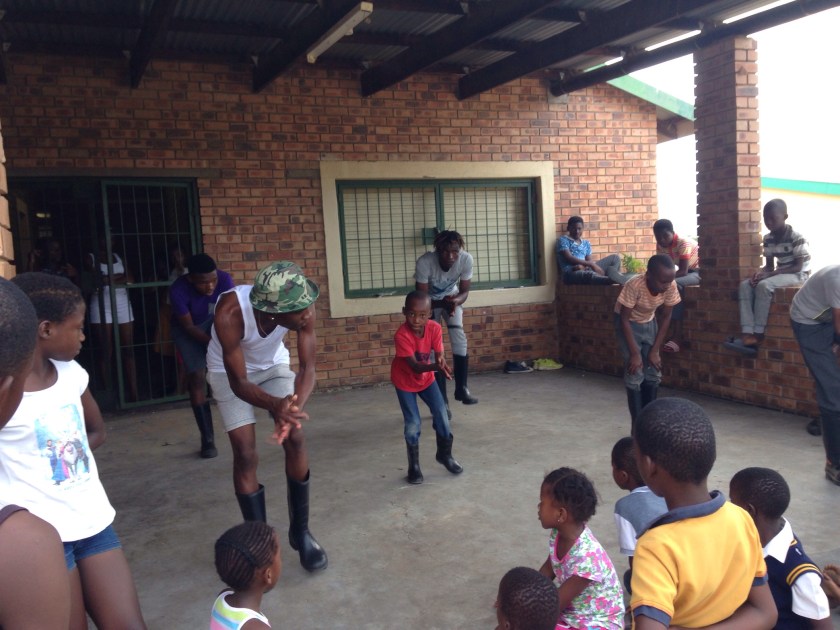 We didn’t get back to school until the late afternoon. Fortunately, I was in time to watch the after-school program’s gum shoe dance group practice! The final act of the after-school program was to give all the students a sandwich, apple and glass of juice as they left at 4:30. The students hadn’t eaten anything since the morning snack break at 10:00 am. The after-school center won’t be open for the national holiday tomorrow because they’d have to feed the students a mid-day meal and don’t have the money for it.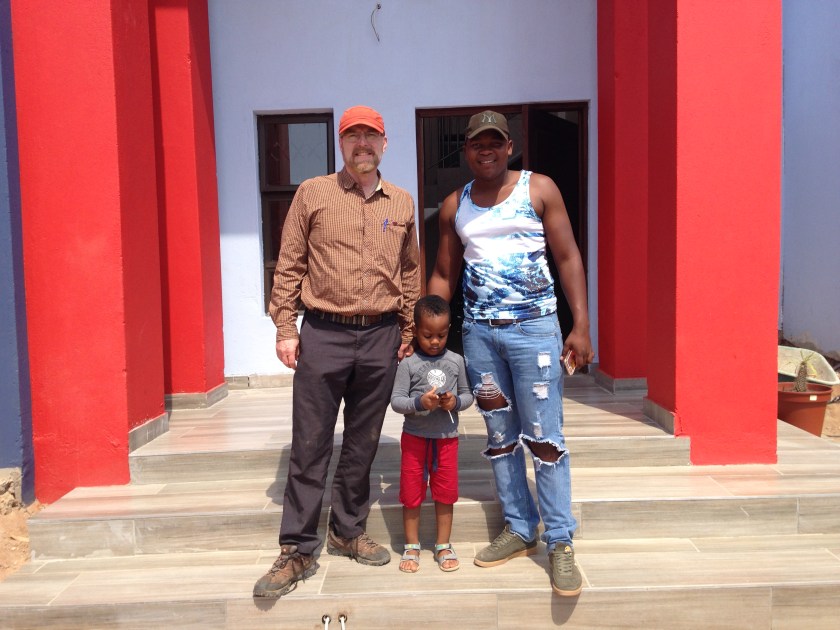
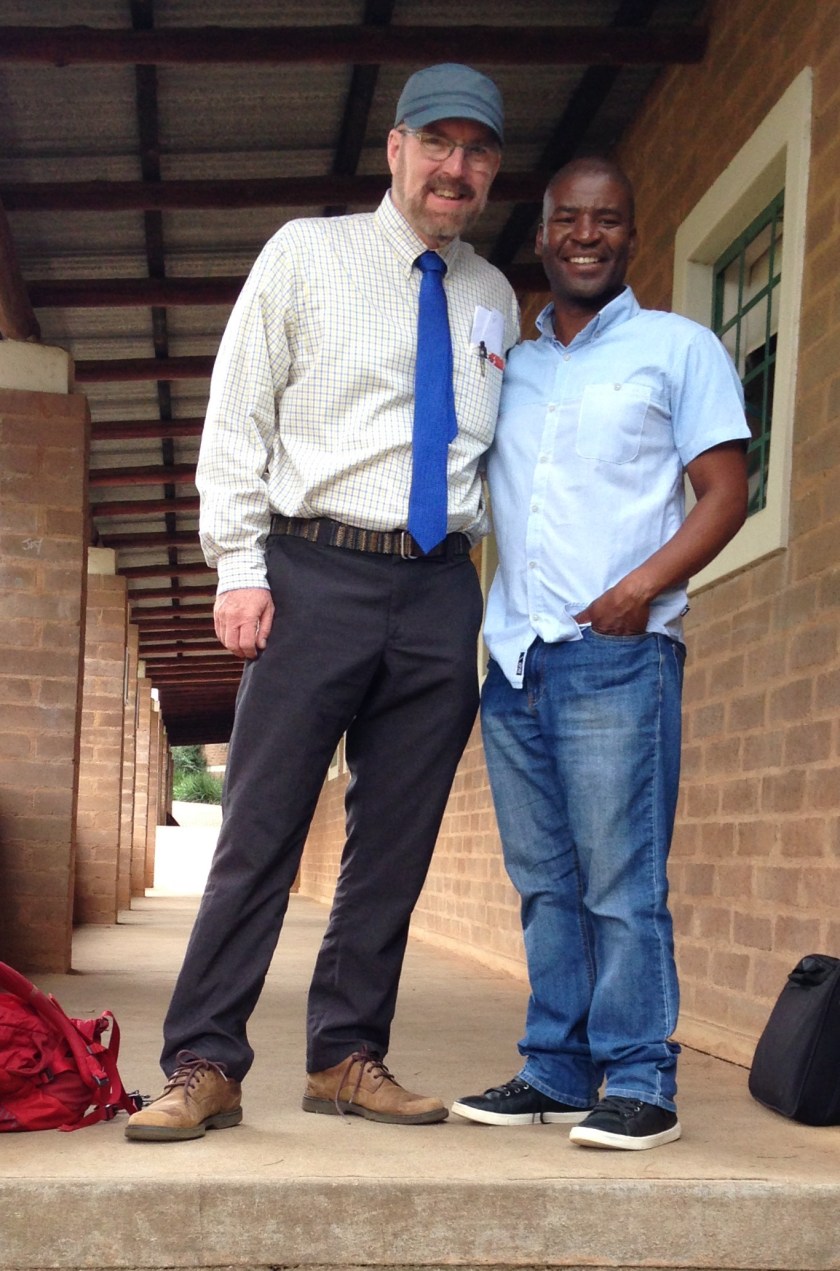 At Penryn, I sat in on a drama class. The students were working in small groups developing brief plays. The play had to address a problem in modern South Africa (such as income inequality, the oppression of women or corruption) and had to do it using post-modern theatrical techniques. In one play, the students were the admissions committee at a university. Jacob Zuma’s child had applied and had very poor marks; however, the committee members had all been paid a bribe and so his child was admitted. A colored student was admitted to diversify their student body. A white student with outstanding marks and accomplishments applied. The admission committee in unison chanted REJECTED!
  I am in the White River area for ten days scouting out a service-oriented Athenian School trip I hope to lead next year. Round Square organized service projects in this area for several years and my host is the local woman that Round Square worked with, Lis Macintosh. Liz is white and from Zimbabwe, having left soon after the country gained its independence with Robert Mugabe as its leader. A big topic in South Africa is land redistribution. The ANC is looking to amend the constitution to allow land redistribution without paying the current owner. Liz and a friend were talking about this last night, reassuring themselves that South Africa would not become another Zimbabwe.
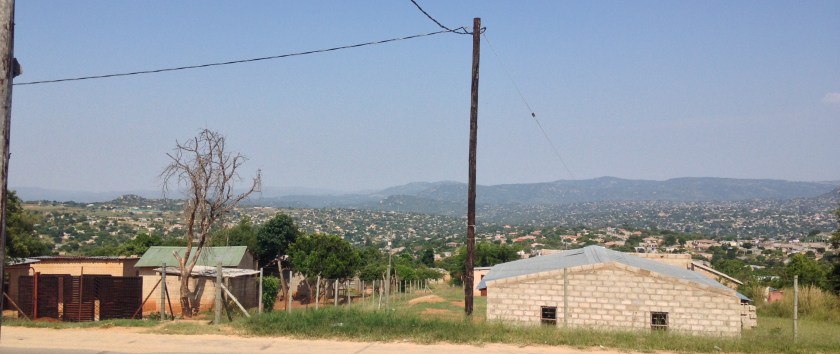 Neeto said that older blacks think that conditions were better under apartheid than under the democratically-elected ANC government. I asked him how this could be. He said that the levels of corruption were so high that there was less money to spend in the townships now. I said that it seemed that if that was true they should change the government. He said that wouldn’t make any difference because all politicians are the same. This is a black man who has been very successful. He was recently honored as the Entrepreneur of the Year in Mpumalanga province. Yet, he feels hopeless and powerless.
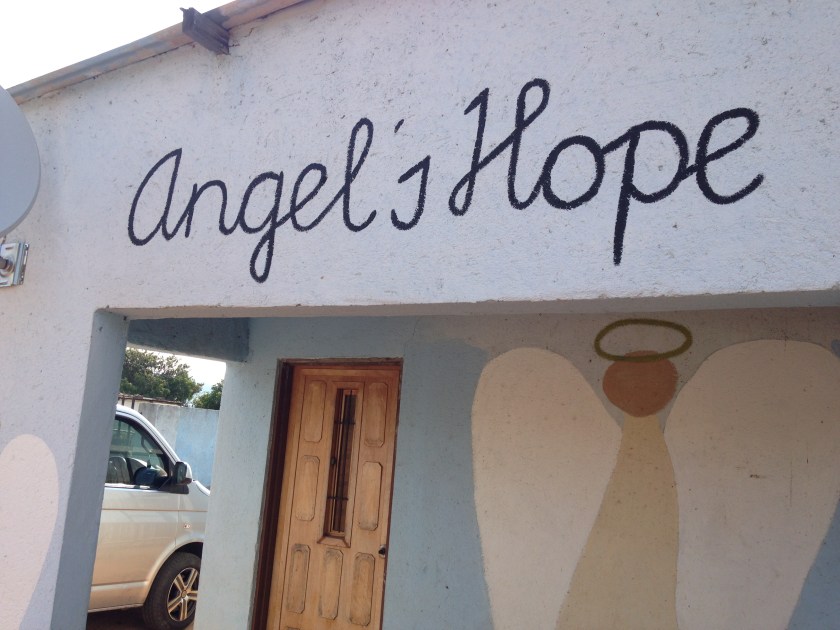 Neeto took us to an orphanage that he and Liz support named Angel’s Hope. The orphanage has 14 children and is run by Mary and her husband, Jacobus. Jacobus was sitting with his feet raised and told us his doctor said he should rest. I assumed he had some injury to his feet. As we drove away, Neeto reported that Jacobus had kidney failure. Neeto continued: ‘In South Africa, if you don’t have money, you die.’
 Class size for most government schools in South Africa runs from 45 to 90 students. A ranking of education systems by the Organization for Economic Co-operation and Development (OECD) placed South Africa 75 out of 76. In other words, South Africa ranks behind many poorer nations. For example, in Tanzania only 4% of students who have completed six years of schooling can’t read. In South Africa, the figure is 27%!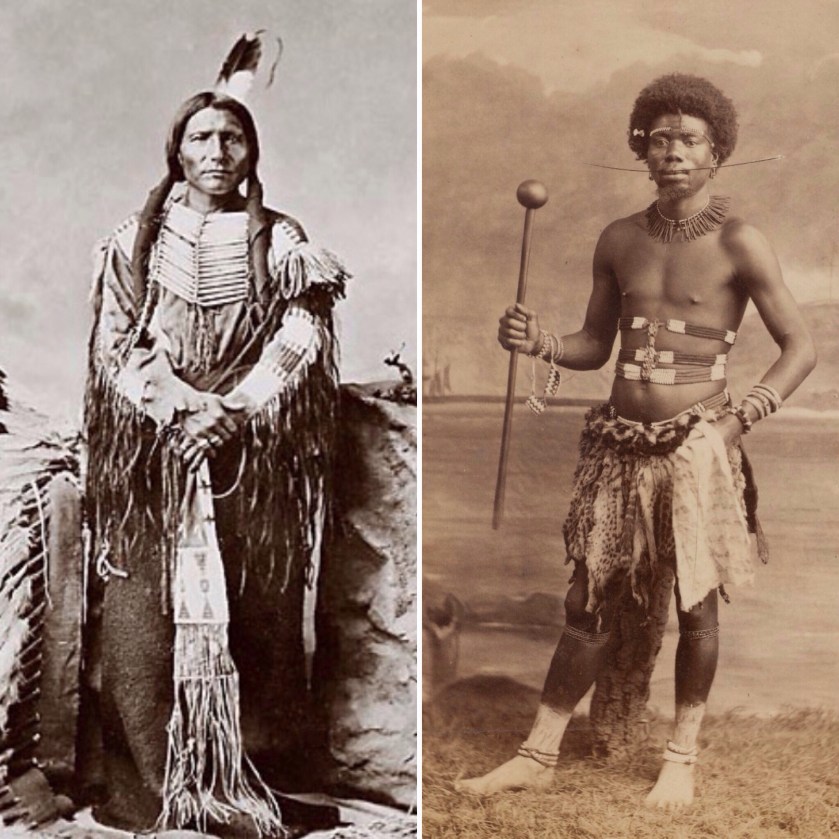
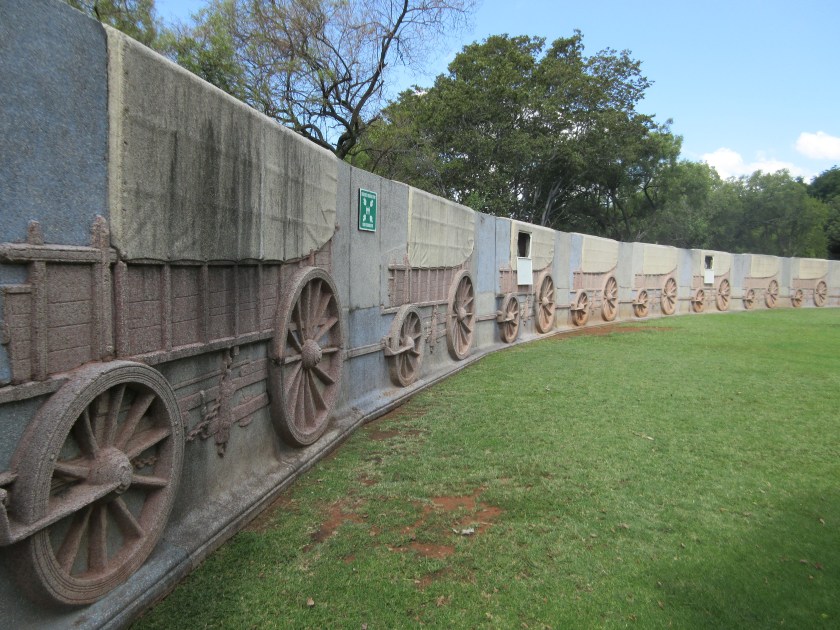
 Monday morning, I took Uber to central Johannesburg to tour Constitution Hill. I had a ticket for the 10:00 am full tour, but they asked if I would come back at 1:00. I went to explore central Jo’burg and, another Uber ride later, I was at Mary Fitzgerald Square (a labor leader). The area around the square looked sketchy and, given all the safety warnings I’ve been given, I headed in the other direction. I took a left at the first street. Suddenly the mood changed. There was an outdoor café across the street from a theatre–and there was a large mall just next to that. It turns out the South African International Film Festival is at that theatre this week and so I bought a ticket for the film at 8:00 that night.
 Constitution Hill is the site of an old jail, built before the city of Johannesburg was founded. A fort was added after the Jameson Raid in 1895, an attempt by the British to annex the area after gold was discovered. The jail was closed in the 1980s. After the end of apartheid in 1994, part of the prison was torn down and reconstructed to be the court buildings for the supreme court in South Africa—hence the name Constitution Hill.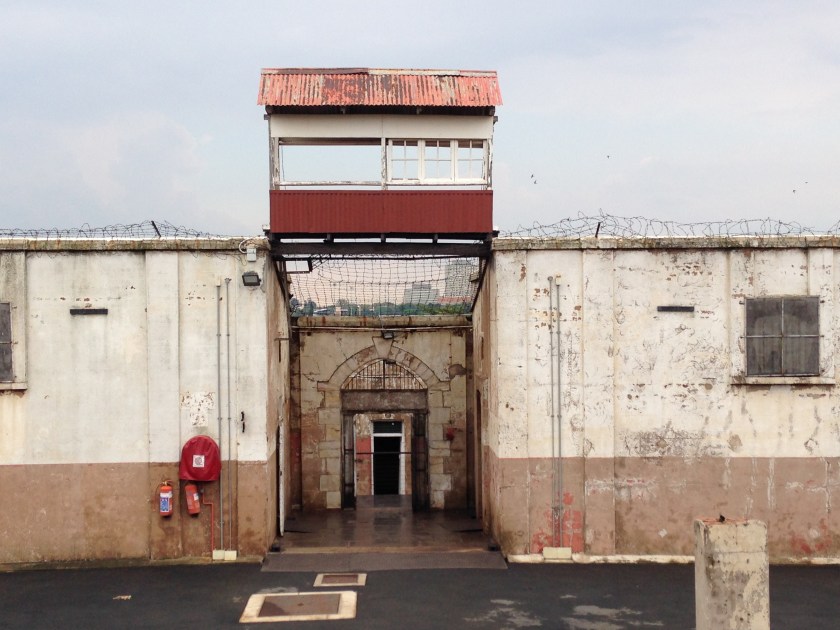
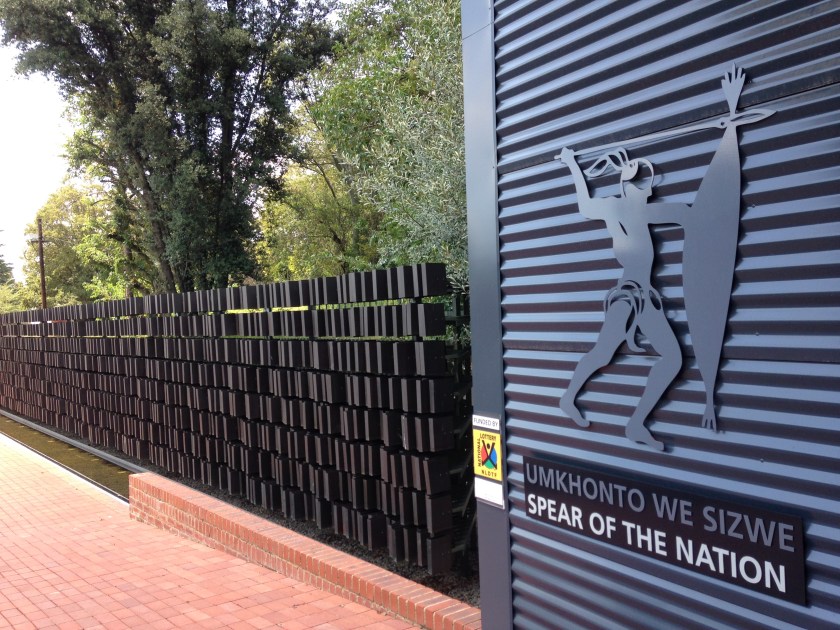 On Tuesday, I visited Liliesleaf Farm in the suburb of Rivonia. The farm was a secret meeting place for the African National Congress (ANC), which was a banned organization in South Africa for many decades. The ANC was worried that too many people knew about the farm’s existence and held one final meeting there. The police conducted a raid that very day and captured all the senior leadership of the ANC, which was a major setback for the liberation struggle. Nelson Mandela had been recently captured, the CIA providing all the information that led the South African Security Forces to him. The Rivonia Trial in 1963 included those arrested at the farm and Mandela. They were all convicted to life sentences—this is the sentence that sent Mandela to Robben Island for 30+ years—but the defendants were able to use the trial to publicize their cause to an international audience. It was interesting being at a museum site where the perspective provided was so opposed to that of the country’s government when the event occurred.
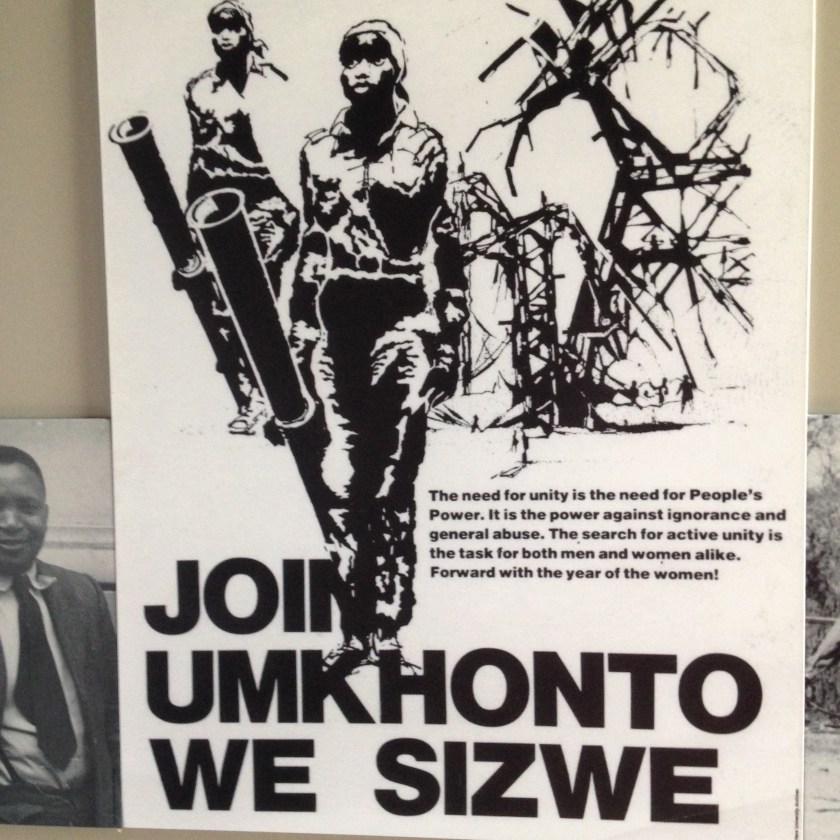 On Wednesday, I was off to the African Leadership Academy. This is a unique school. It has 250 students from 40 African nations. Only 5% of the students are from South Africa, so it truly is a pan-African institution. They run a two-year program, which is the last two years of secondary school for some and comes after graduation from secondary school for others. In addition to traditional subjects, the school has three focus areas: entrepreneurial leadership, African history, and writing & rhetoric.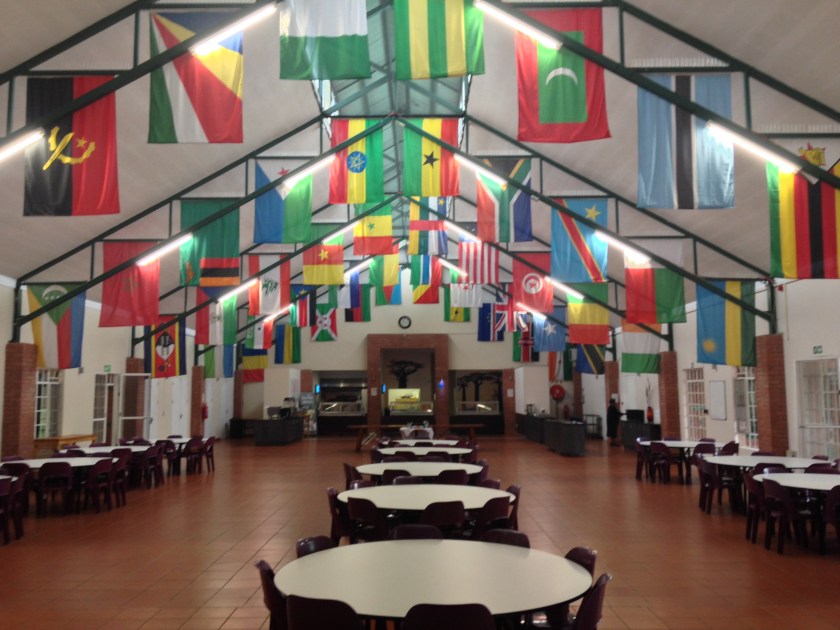
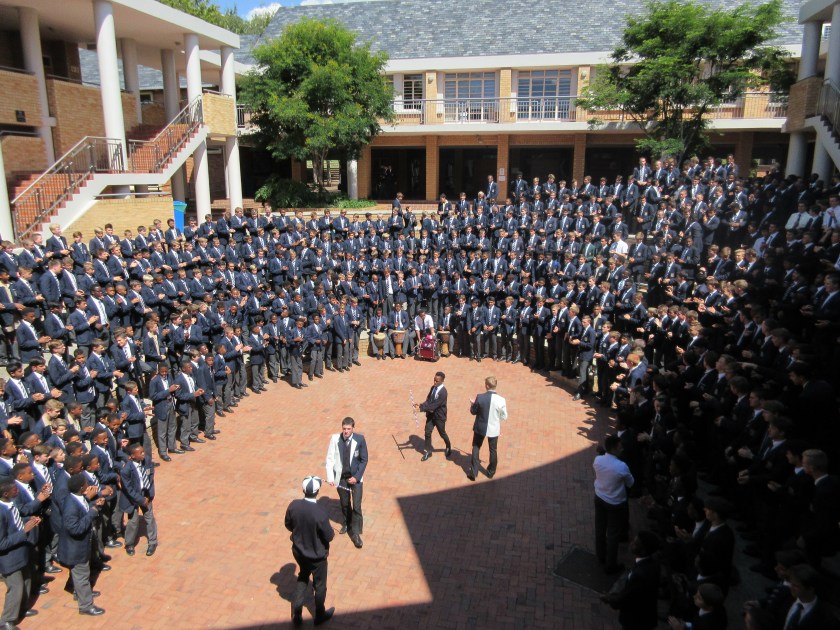 There were no classes during the last period of the day so that the boys, all 800+ of them, could practice the ‘war cries’ they chant at sporting events. This was quite a ritual to witness. One chant was a song that had revised lyrics to John Denver’s Take Me Home, Country Roads.
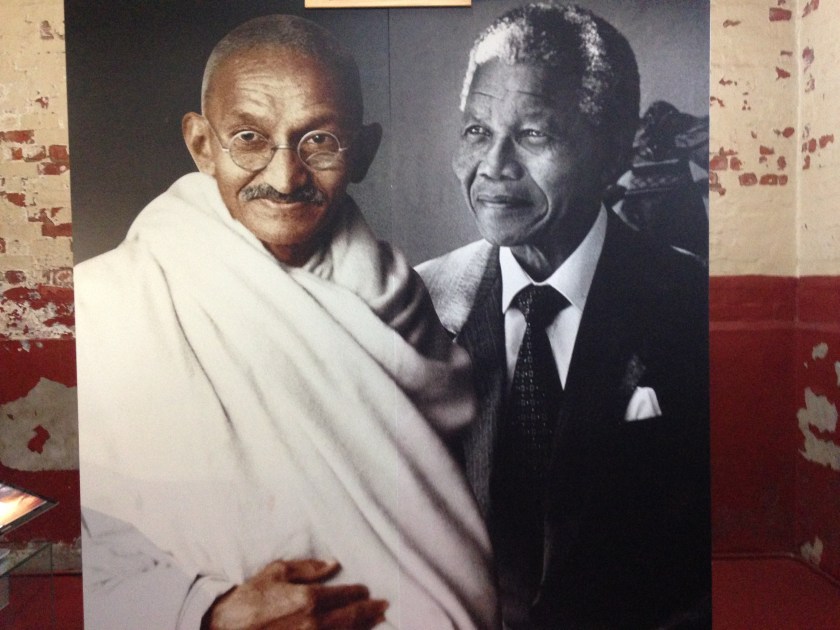 3. In Johannesburg you can visit monuments to white pioneers as well as the homes—and prisons–where Nelson Mandela and Mohandas Gandhi stayed.
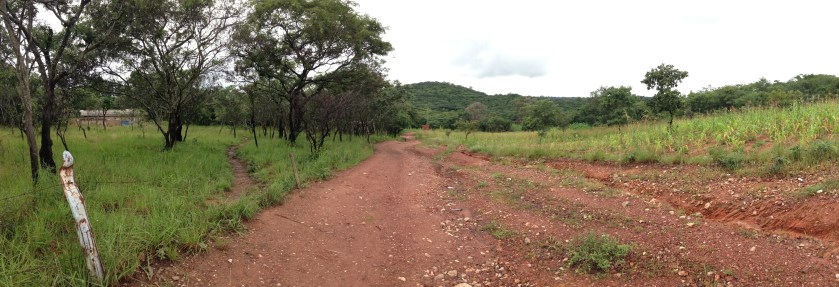 The walk to Appleseed each morning is one of the highlights of my day. The first half is on dirt roads past corn fields and green woods. Then I turn a corner and am looking down a paved road into the Bauleni compound. The streets and pathways of Bauleni seem to always be full of people. The men look like they could have stepped off the streets of Oakland, while most of the women are wearing a chitenge, a traditional wrap around skirt.
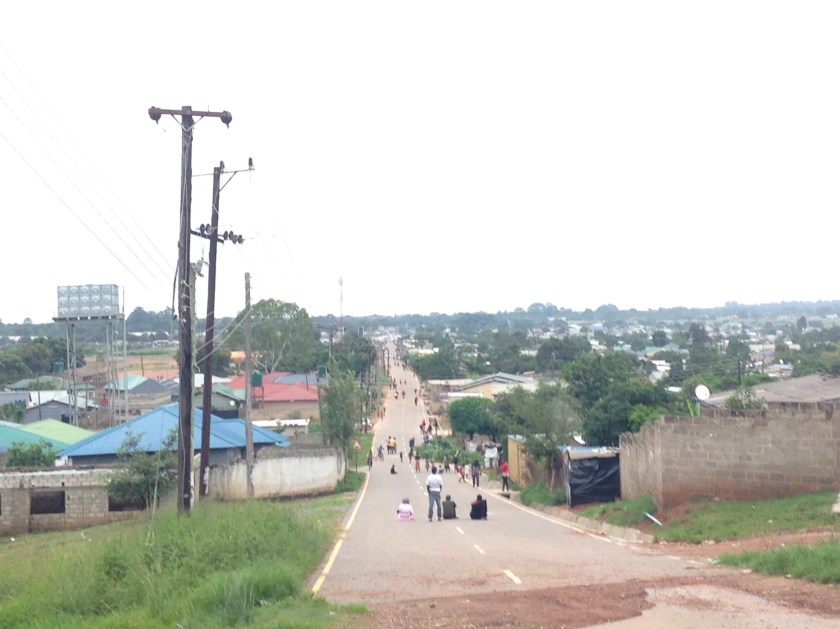 I pass small homes made of cinder blocks, often with long lines of clean clothes out to dry. The 3 and 4-year-olds playing in the dirt often call out ‘mzungu’ as I pass. Mzungu is the one Swahili word I’ve heard here and means European/white person. Interestingly, the use of the word began hundreds of years ago when European explorers arrived in East Africa. Mzungu is based on the Swahili word for a person who wanders around aimlessly. Perhaps the word is more fitting for me than I acknowledge.
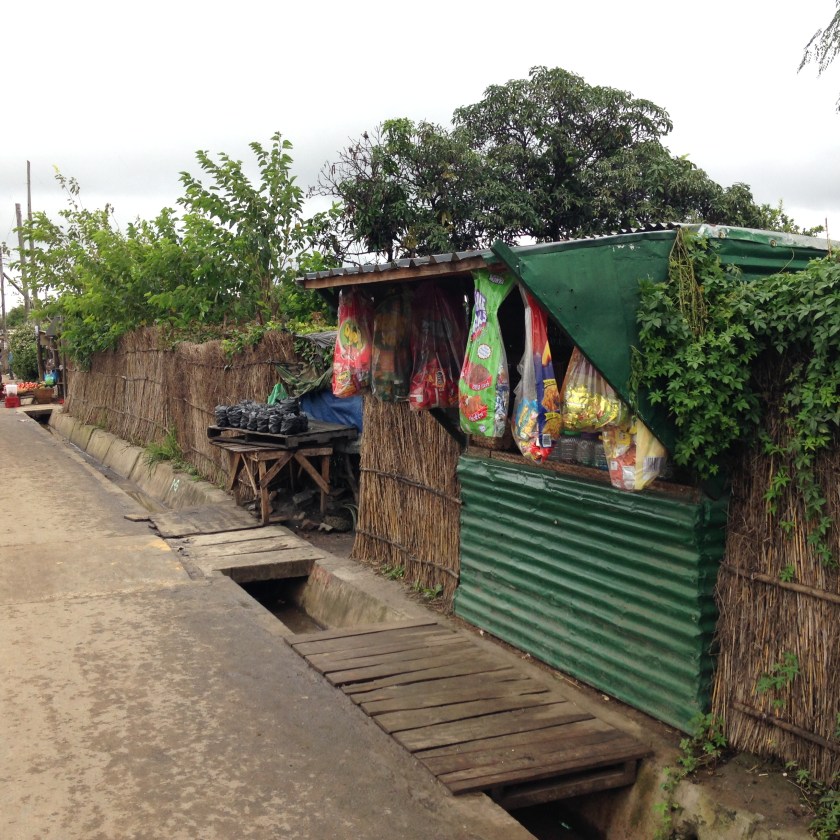 I pass tiny shops with piles of four tomatoes, small plastic bags of charcoal, and small bags of potato chips that are more packaging than food. Some of the shops are painted the distinctive color of one of the mobile phone companies—yellow for MTN, green for Zamtel, red for Airtel. I pass two elementary schools—one of them has over 4,000 students–and a dirt/mud football pitch. I make a right turn at the second big green water tank, where people with plastic buckets gather for cholera-free water.
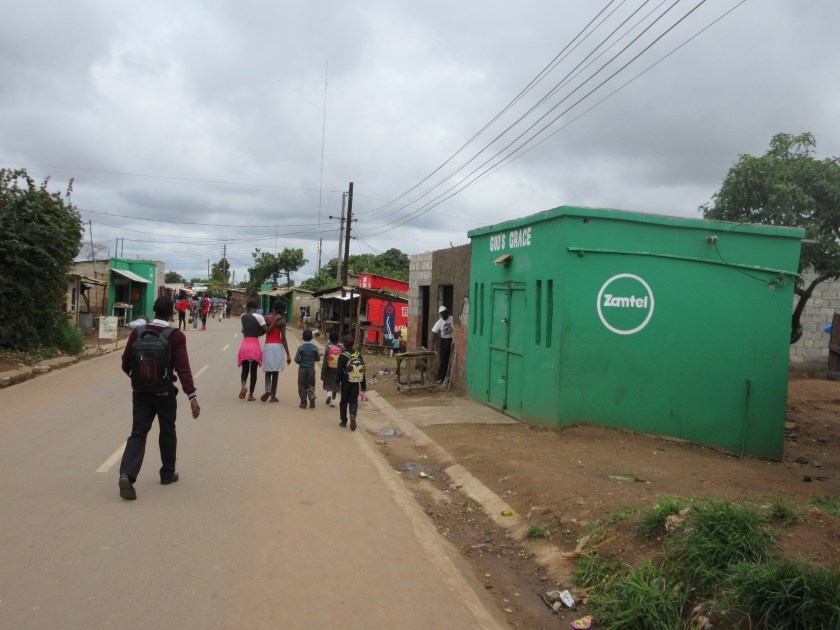 Appleseed is up the road from a little shopping district in Bauleni. There is tiny hardware store, a few ‘business centers’ with a computer and printer, and a ‘barbar’ shop. For the furniture makers, both the production and the show room are outside. The wood is all planed by hand, which is physically demanding, and the product line appears to be mostly bed frames and wooden doors. As we get closer to Appleseed, I run into young people who know me and call out my name to say hi.
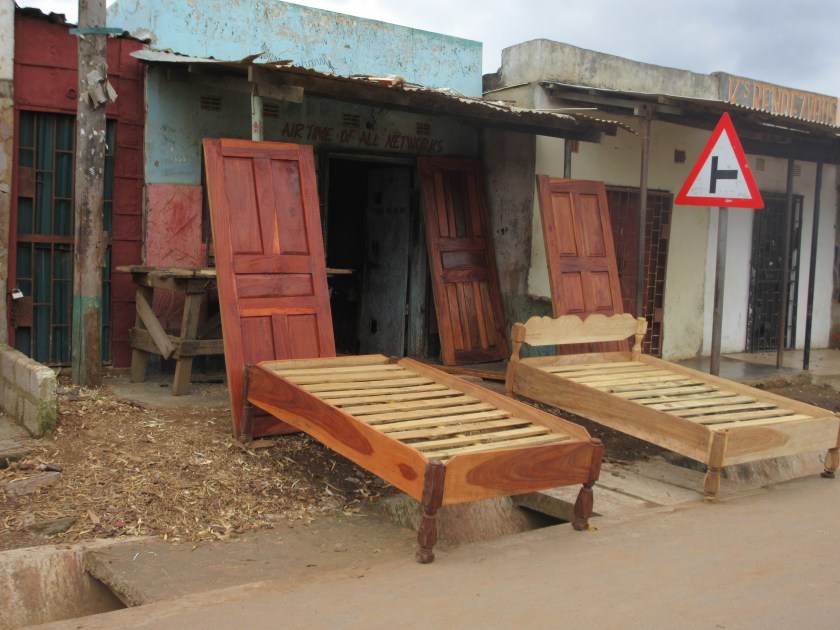 If I arrive at Appleseed early enough, the daily morning clean-up is still going on. There is so much dust and dirt that Appleseed needs to be cleaned every morning—and the floor and yard swept a couple of times during the day. The computers all have cloth covers over the keyboard, screens and CPU towers overnight to keep out dust and dirt.
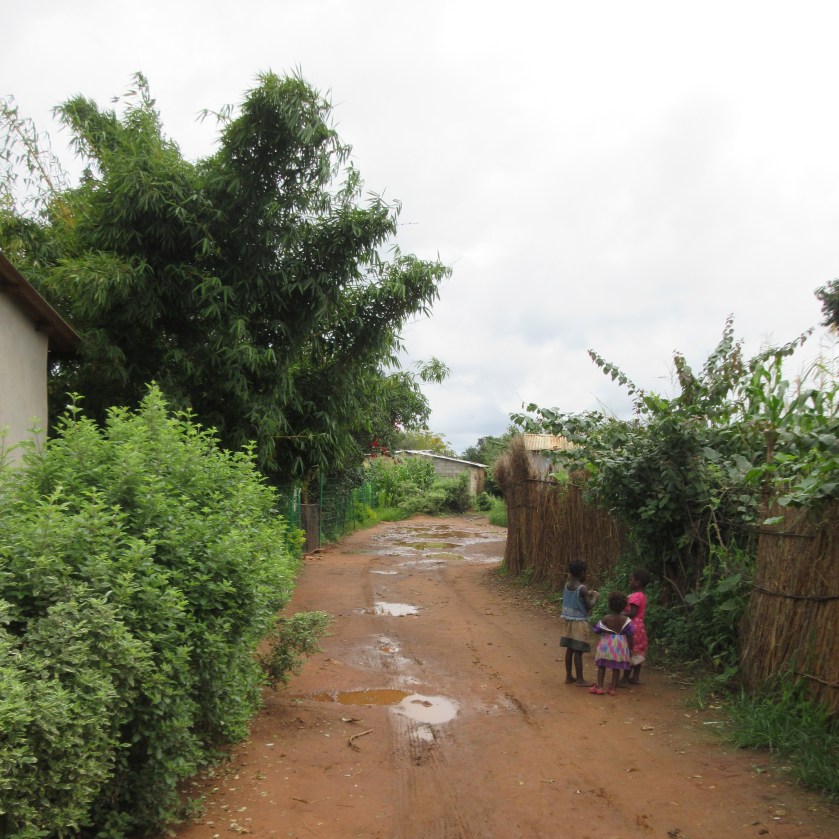 There are always young people at Appleseed during the school day and on arrival I look for some to interact with. The local schools run in two shifts with half the students attending from 8-12 and half from 12-4. Most people here are tri-lingual–Bembe, Nyanja and English–but English is learned last. This mean I usually work with the 10-13 year olds. We read books, play games, do homework, sing songs. They are vivacious, bright and beautiful. They speak three languages, but their academic training is pitiful. Several of my favorite 13-year old read at the level of a second or third grader. The little book where I keep notes is full of words they’ve asked me how to spell, such as friend, brother, mother, don’t, love and lovely, thank you, so much and sponsor.
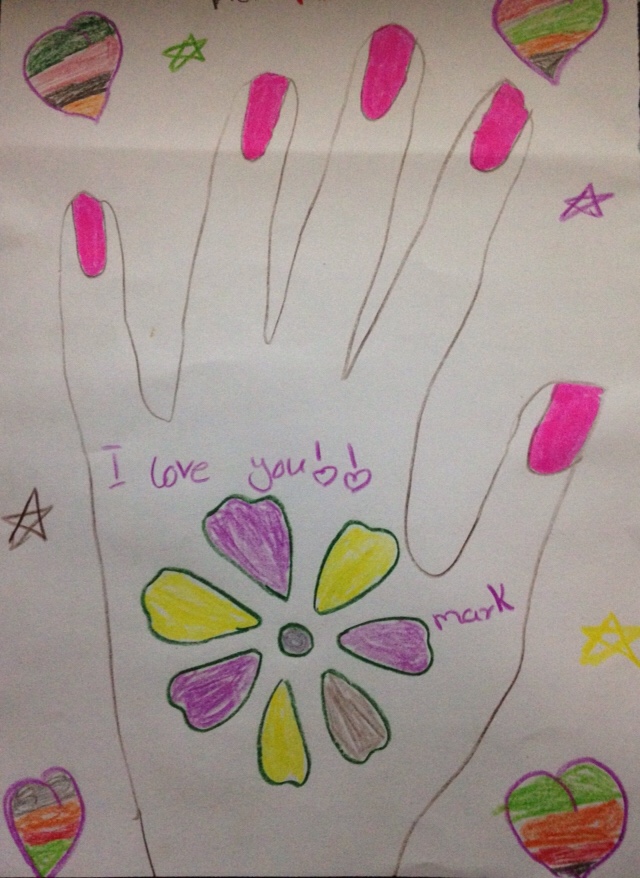 One of their favorite activities is to make drawings and cards. There are lots of colored pencils and because I’m here they have better access to the precious white paper. I have received dozens of beautiful pictures and cards full of hearts and ‘I love you.’
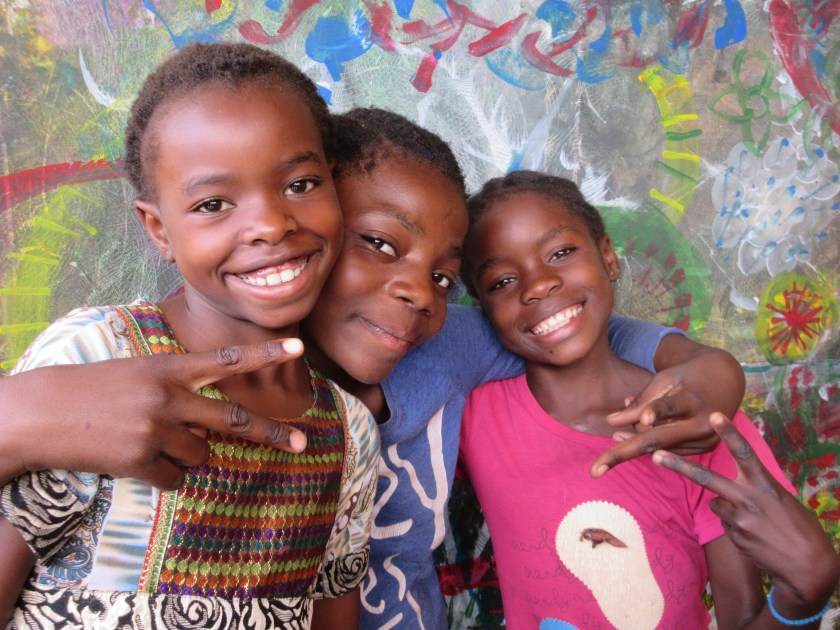 Ken, Joy, Jenny and Lucy drive to Appleseed after school each day around 4:00 to pick me up. Jenny and Lucy have many friends here and so they may play, while Ken and Joy talk with people and solve problems. Then it’s over the hill and back to their house behind the wall.
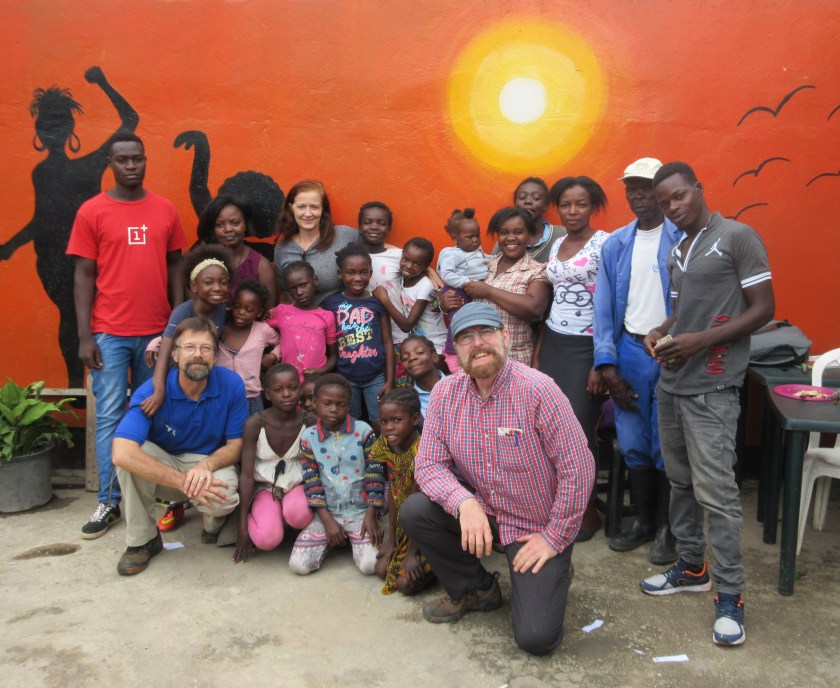 It has been an honor and a treat to be here for two weeks, to be part of the Bauleni compound, to work with the adults and young people at Appleseed, to live with Ken, Joy, Jenny and Lucy. Tomorrow I catch a plane back to Johannesburg. A way of life is ending.
 No Foreign Lands